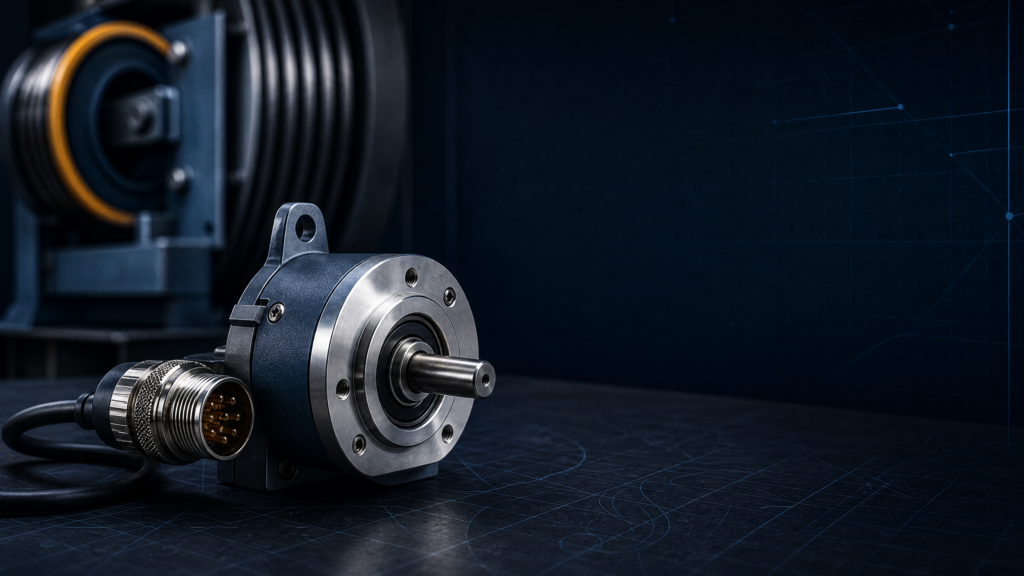
An elevator encoder provides position or speed feedback for equipment such as a traction machine, governor or door operator. Because encoder specifications vary significantly, ordering from a generic description alone can create an avoidable compatibility risk. The safest approach is to identify the installed encoder completely before asking for a replacement quote.
Record the full label and mechanical details
The original label is the most useful starting point. Photograph it clearly and capture the manufacturer name, complete model, serial or revision information, voltage, output format and any suffixes. A suffix may indicate a different connector, cable length, shaft design, resolution or mounting configuration.
Key specifications to verify
- Application: traction machine, speed governor, door operator or another component.
- Mechanical fit: shaft style and diameter, flange or mounting arrangement, housing dimensions and cable exit direction.
- Electrical connection: connector type, pin count, cable length, supply voltage and output interface.
- Feedback requirement: resolution or pulse count and the signal format specified for the installed controller or drive.
- Equipment context: brand and model of the associated traction machine, controller or door system.
Do not assume similar-looking encoders are interchangeable
Two units may look almost identical while having different electrical output, resolution, connector wiring or firmware identification. A fit check should therefore cover both mechanical and electrical requirements. If the old part is unavailable, provide photos of the mounting position, connector and associated equipment label so that the application can be assessed.
Make the quotation process faster
Include the required quantity, destination country and whether you need the encoder only or a matching cable/connector assembly. This reduces back-and-forth and helps the supplier identify whether an exact part, compatible alternative or additional verification is needed.
Need help identifying an encoder?
Use the elevator parts catalogue as a starting point, then send an RFQ with the label photo and equipment details. Selection and installation should always be reviewed by qualified elevator technicians.