Description
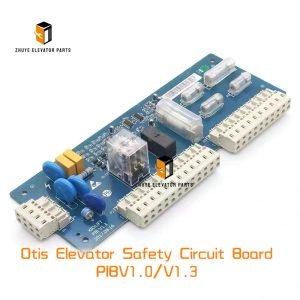
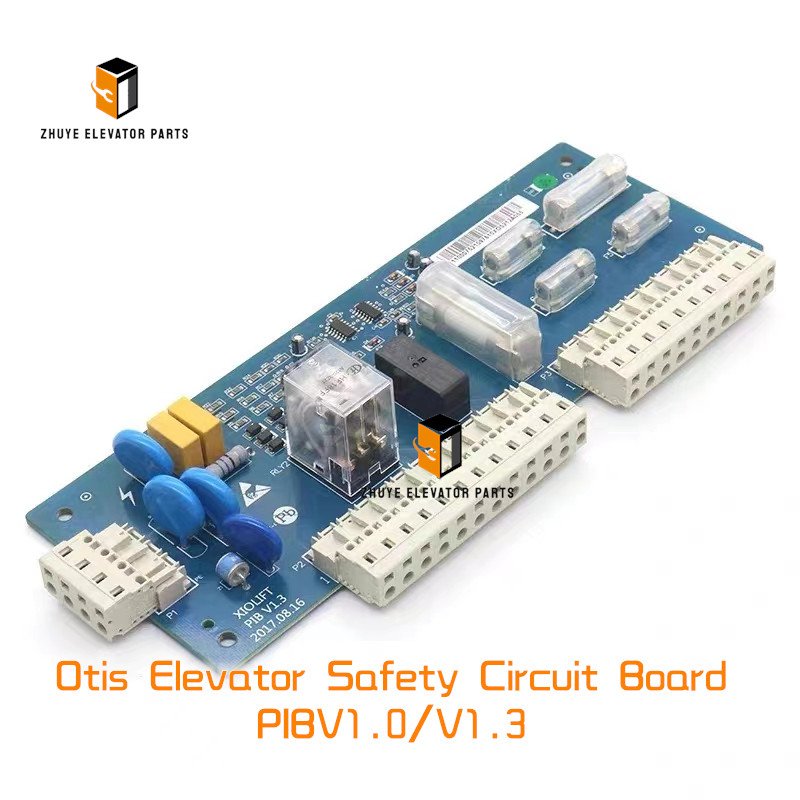
Otis Elevator Safety Circuit Board PIBV1.0/V1.3 Brief Introduction
|
Product Name |
Otis Elevator Safety Circuit Board |
| Model Number | PIBV1.0/V1.3 |
|
Quality
|
Original.Brand New
|
|
Payment
|
T/T. Paypal. Western Union
|
|
Delivery
|
3-5 Working Days
|
|
Packaging
|
Packed by carton
|
Nanjing Zhuye Elevator Parts – Otis Elevator Safety Circuit Board PIBV1.0/V1.3: Installation, Commissioning & Replacement Guide
Passenger safety in an Otis elevator is never left to chance—it is hard-wired into a dedicated sentinel known as the PIB safety circuit board.
Part numbers PIBV1.0 (legacy) and PIBV1.3 (current) aggregate door locks, governor switches, emergency-stop contacts and car-gate contacts into one fail-safe chain that meets EN 81-20 Category 3 requirements.
Nanjing Zhuye Elevator Parts has imported, flash-tested and stocked brand-new, factory-sealed PIBV1.0/V1.3 boards since 2014, shipping over 6 000 units to 47 countries.
Below we explain how to select the correct version, wire the chain and—crucially—when to replace this life-safety module before aged relays or a tired opto-isolator break the chain and initiate an unplanned stop.
Part numbers PIBV1.0 (legacy) and PIBV1.3 (current) aggregate door locks, governor switches, emergency-stop contacts and car-gate contacts into one fail-safe chain that meets EN 81-20 Category 3 requirements.
Nanjing Zhuye Elevator Parts has imported, flash-tested and stocked brand-new, factory-sealed PIBV1.0/V1.3 boards since 2014, shipping over 6 000 units to 47 countries.
Below we explain how to select the correct version, wire the chain and—crucially—when to replace this life-safety module before aged relays or a tired opto-isolator break the chain and initiate an unplanned stop.
-
Decoding the suffix PIBV1.0 = 24 VDC logic, 16 safety inputs, 8 force-guided relays, 2 OSSD outputs, 2 × RS-485 (group + service), relay life 1 million cycles
PIBV1.3 = V1.0 + reinforced 4 kV isolation, built-in self-test (BIT), LED bar-graph for quick diagnostics, MTBF 120 kh @ 40 °C
Both versions share the same 180 × 120 mm footprint, 11-way pluggable terminals, –25 °C to +70 °C rating and UL 508 recognition. -
Safety first—lock-out & verify The PIB sits on the 24 VDC logic rail but switches 110 V safety contacts.
Lock the main disconnect, engage the car-top inspection switch and wait 60 s for the 110 V rail to fall below 5 V.
Keep the new Nanjing Zhuye PIB in its anti-static bag until mounting—CMOS safety logic can latch at 15 V static. -
Mechanical mounting—keep it cool Snap the PCB onto 35 mm DIN rail inside the controller.
Maintain 50 mm clearance above and below; every 10 °C rise halves relay contact life.
If the cabinet is < 150 mm deep, mount vertically with terminals down—this allows convection chimney.
Nanjing Zhuye supplies a free DIN clip (NY-DIN-PIB) for panel-mount when rail space is tight. -
Wiring map (print and stick inside door) 24 V & 0 V – 1.5 mm², 105 °C silicone, torque 0.8 N·m
Safety inputs – 1.0 mm², 600 V, torque 0.6 N·m (dry contacts only)
OSSD outputs – 0.5 mm², 30 V 1 A, torque 0.5 N·m
RS-485 – twisted pair, 120 Ω termination at last node (DIP-1 ON)
Earth – 4 mm² green/yellow to cabinet PE; relay leakage 0.3 mA -
Power-up & self-test Apply 24 VDC; green “PWR” LED steady, red “FLT” off.
Built-in test (BIT) runs for 3 s: all relays cycle, OSSD pulse, RS-485 echo.
If any LED fails, the board locks out and transmits “E-SAF” over the bus—replace immediately. -
Relay functional test (per EN 81-20) With the car on inspection, open each safety contact in turn; the corresponding relay must drop and OSSD must go low (< 0.5 V).
Force-guided contacts are linked; if one welds, the other opens—verify with ohmmeter < 1 Ω closed, > 10 MΩ open.
Document the test report; inspectors love to see it. -
Temperature & lifetime model Relay contacts: 1 million cycles; at 300 door cycles/day = 9 years.
Opto-isolators: 50 kh @ 70 °C, double every 10 °C drop.
Capacitor C1 (47 µF, 35 V): 2 000 h @ 105 °C, 64 kh @ 45 °C.
Translate to building traffic: Light traffic (office, 150 cycles/day) – relays ≈ 18 years, optos ≈ 25 years, full board ≈ 15 years; inspect every 3 years. Medium traffic (mall, 400 cycles/day) – relays ≈ 7 years, optos ≈ 12 years, full board ≈ 8 years; inspect every 2 years. Heavy traffic (metro, 800 cycles/day) – relays ≈ 4 years, optos ≈ 6 years, full board ≈ 5 years; inspect every 12 months. -
Built-in test (BIT) diagnostics (PIBV1.3 only) Press and hold TEST button 3 s; LED bar runs left-to-right.
Any segment stuck off indicates a failed channel—replace board.
BIT result is transmitted over RS-485; remote BMS can log it for predictive maintenance. -
Preventive inspection checklist Monthly: visual LED bar, listen for relay clicking during door cycle. Quarterly: measure 24 VDC ripple at J1; > 200 mVpp indicates supply fatigue. Annually: megger safety contacts to PE > 100 MΩ; < 10 MΩ indicates carbon track. Bi-annually: torque test 24 V and safety screws; vibration loosens them, causing intermittent “E-SAF”.
-
Rapid swap (downtime < 10 min) a) Power down, lock-out, wait 60 s. b) Photograph J1-J3 and safety wire numbers with phone. c) Remove DIN clip, slide old board out. d) Insert new Nanjing Zhuye PIBV1.0/V1.3, snap onto rail. e) Restore wires in exact order, ferrule and torque 0.8 N·m. f) Power up, run BIT, verify green LED. g) Run safety-chain functional test. h) Log serial number and cycle counter; return old unit for recycling.
-
Recycling & sustainability Nanjing Zhuye offers prepaid DHL labels inside every carton. Returned boards are stripped: gold fingers go to certified refinery, plastic housing re-granulated, relay silver recovered. One recycled PIB saves 2.1 kg CO₂—enough to power the same controller for a week.
By treating the PIBV1.0/V1.3 as the safety heart of the elevator—not just another “relay board”—you eliminate mysterious chain breaks, reduce inspection defects and keep passengers confidently protected. Specify Nanjing Zhuye genuine stock, follow the cycle-based replacement table above, and the only thing your safety circuit will ever say is “all clear”—trip after trip, year after year.