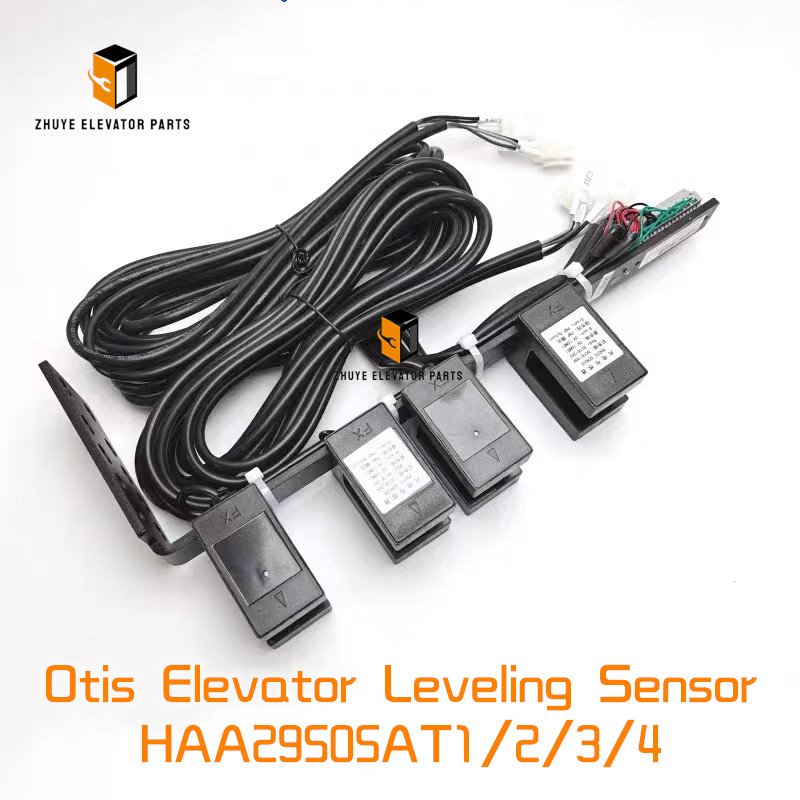


Description
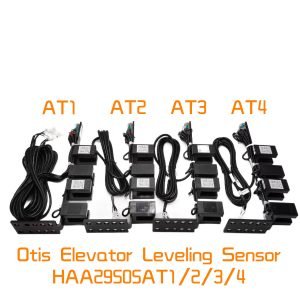
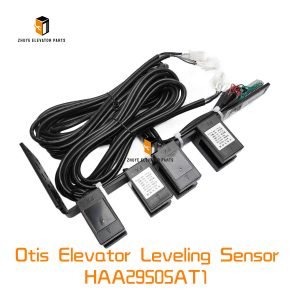
Otis Elevator Leveling Sensor HAA29505AT1/2/3/4 Brief Introduction
|
Product Name |
Otis Elevator Leveling Sensor |
| Model Number | HAA29505AT1/2/3/4 |
|
Quality
|
Original.Brand New
|
|
Payment
|
T/T. Paypal. Western Union
|
|
Delivery
|
3-5 Working Days
|
|
Packaging
|
Packed by carton
|
Nanjing Zhuye Elevator Parts – Otis Elevator Leveling Sensor HAA29505AT1/2/3/4: Installation, Calibration & Replacement Guide
An elevator can travel at 2 m/s all day, but if it stops 5 mm above the floor, passengers notice. Otis part numbers HAA29505AT1, AT2, AT3 and AT4 are the active, contact-less leveling sensors that tell the controller exactly where the car is relative to each landing. Nanjing Zhuye Elevator Parts has imported, calibrated and stocked brand-new, factory-sealed HAA29505AT sensors since 2013, shipping over 10 000 units to 51 countries. Below we explain how to select the correct suffix, mount the sensor and—crucially—when to replace it before drift or dust turns a perfect stop into a tripping hazard.
-
Decoding the suffix HAA29505AT1 = 24 VDC PNP, 4 mm sensing distance, 2 kHz switching frequency, M12 barrel, 2 m PUR cable
AT2 = 24 VDC NPN, 4 mm, M12, shielded for high EMI sites
AT3 = 110 VAC 2-wire, 5 mm, M18, for legacy controllers
AT4 = 24 VDC analogue 0–10 V, 8 mm, M18, for high-precision leveling (±1 mm)
All versions share the same –25 °C to +70 °C range, IP67 front, LED status indicator and short-circuit protection. -
Safety first—lock-out & verify Although sensors are low-voltage, the car-top can still hold 110 VDC on the brake. Lock the main disconnect, engage the car-top inspection switch and wait 60 s for the 24 V rail to fall below 5 V. Keep the new Nanjing Zhuye sensor in its anti-static bag until mounting—CMOS output stages can latch at 15 V static.
-
Mechanical mounting—keep the gap The sensor threads into an M12 (AT1/2) or M18 (AT3/4) steel bracket welded to the car cross-head. Use the supplied nyloc nut; torque 15 N·m (M12) or 25 N·m (M18). Aim the face perpendicular to the steel vane on the rail; angular deviation > ±3° reduces sensing distance 10 %. Maintain 2 mm clearance (AT1/2) or 3 mm (AT3/4) to the vane; every 0.5 mm of dust build-up equals 0.3 mm level error.
-
Wiring map (print and stick inside controller) AT1/2: Brown = +24 V, Blue = 0 V, Black = PNP/NPN output, Shield = PE at controller end only
AT3: Brown = 110 V L, Blue = 110 V N, load current 8 mA, no neutral connection to sensor
AT4: Brown = +24 V, Blue = 0 V, White = 0–10 V out, 100 Ω min load, Shield = PE
All cables: PUR sheath, 2 m standard; Nanjing Zhuye offers 5 m and 10 m variants (NY-CAB-ATxx). -
Power-up & functional test Apply rated voltage; LED should be off (no target). Insert a 4 mm (AT1/2) or 8 mm (AT4) steel feeler gauge; LED turns on and output switches. Measure switching point with dial gauge: repeatability must be < 0.1 mm. If hysteresis > 0.3 mm, vane edge is rounded—file flat or replace vane.
-
Calibration (AT4 analogue only) Place car at exact floor level (verified with machinist rule). Multimeter on white wire: adjust VR1 until output = 5.00 V ±0.02 V. Move car ±10 mm; voltage should change ±2.00 V ±0.05 V. Record gradient in controller parameter LVL-GAIN; > 5 % error triggers “E-LEVEL” fault.
-
Temperature & lifetime model LED emitter: 50 kh @ 25 °C, doubles every 10 °C drop. Capacitor inside AT4: 2 000 h @ 105 °C, 64 kh @ 45 °C. Cable flex: 1 million cycles; at 300 trips/day = 3 years. Translate to building traffic: Light traffic (residence, 60 trips/day) – LED ≈ 30 years, cable ≈ 15 years, full sensor ≈ 12 years; inspect every 3 years. Medium traffic (office, 300 trips/day) – LED ≈ 10 years, cable ≈ 5 years, full sensor ≈ 6 years; inspect every 2 years. Heavy traffic (mall/metro, 1 000 trips/day) – LED ≈ 5 years, cable ≈ 3 years, full sensor ≈ 4 years; inspect every 6 months.
-
Preventive inspection checklist Monthly: visual LED, wipe sensor face with lint-free cloth. Quarterly: feeler-gauge test switching point; > 0.2 mm drift schedules replacement. Annually: megger cable > 100 MΩ; < 10 MΩ indicates oil ingress. Bi-annually: torque check M12/M18 nut; vibration loosens it, causing level drift.
-
Rapid swap (downtime < 5 min) a) Place car at mid-floor, lock-out, tag out. b) Photograph cable colours with phone. c) Unscrew sensor, slide old unit out. d) Thread new Nanjing Zhuye HAA29505AT, torque 15 N·m (M12) or 25 N·m (M18). e) Restore cable, power up, run switching test. f) Calibrate AT4 if fitted. g) Log serial number and gap value; return old unit for recycling.
-
Recycling & sustainability Nanjing Zhuye offers prepaid UPS labels inside every carton. Returned sensors are stripped: stainless barrel re-melted, copper cable recycled, electronics processed for gold and gallium. One recycled sensor saves 0.6 kg CO₂—enough to power the same car-top for a week.
By treating the HAA29505AT family as the precision eyes of the elevator—not just another “prox switch”—you eliminate leveling callbacks, reduce trip hazards and keep passengers stepping out onto a perfectly flush floor. Specify Nanjing Zhuye genuine stock, follow the drift-based replacement table above, and the only thing your passengers will ever notice is that the elevator stops exactly where it should—trip after trip, year after year.