


Description
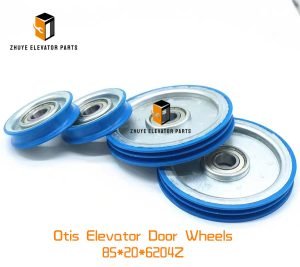
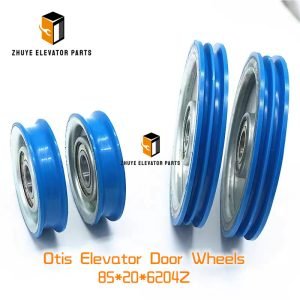
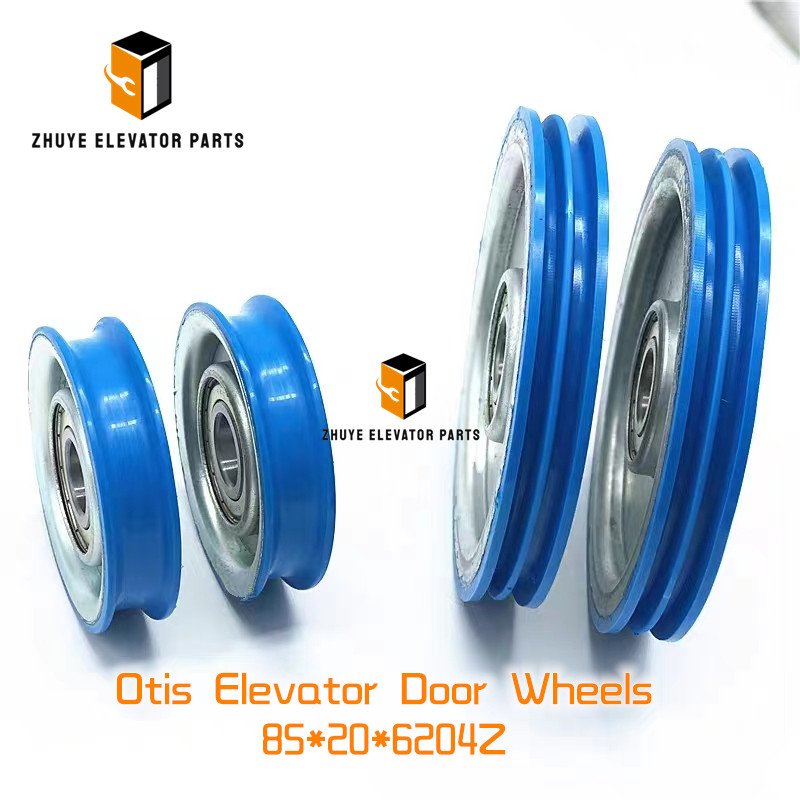
Otis Elevator Door Roller 85*20*6204Z Brief Introduction
|
Product Name |
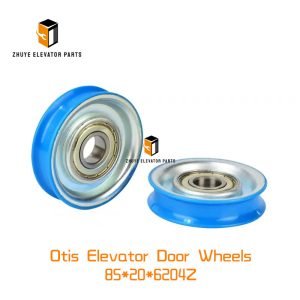
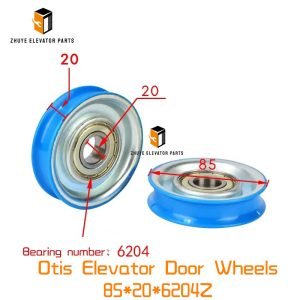
Otis Elevator Door Roller 85*20*6204Z |
| Model Number | 85*20*6204Z |
|
Quality
|
Original.Brand New
|
|
Payment
|
T/T. Paypal. Western Union
|
|
Delivery
|
3-5 Working Days
|
|
Packaging
|
Packed by carton
|
Nanjing Zhuye Elevator Parts: Otis Elevator Door Roller 85 × 20 × 6204Z – Installation, Care & Replacement Guide
When passengers step into an Otis elevator they rarely notice the small polyurethane wheel that lets the door glide open in absolute silence. That wheel—Otis part number 85 × 20 × 6204Z, 85 mm diameter, 20 mm bore, 6204ZZ deep-groove ball bearing core—carries the full weight of the door panel plus repeated impact loads a thousand times a day. Nanjing Zhuye Elevator Parts has produced this roller since 2008, supplying OEMs and service companies in 62 countries. Below we explain exactly how the roller works, how to install it correctly, and how to predict its replacement interval so that a “simple” door roller never becomes the reason for a shutdown or injury.
Product construction
The outer tyre is injection-moulded polyurethane, Shore-A 92, formulated for −30 °C to +80 °C. The tyre is bonded to a micro-finished steel rim that houses a sealed 6204ZZ bearing pre-packed with Chevron SRI-2 grease (−40 °C to +150 °C). A single circlip retains the bearing, allowing field replacement without special tools. Each roller is dynamically balanced to G2.5 grade and tested at 3 000 rpm for five minutes, eliminating the hop that causes premature rail wear.
The outer tyre is injection-moulded polyurethane, Shore-A 92, formulated for −30 °C to +80 °C. The tyre is bonded to a micro-finished steel rim that houses a sealed 6204ZZ bearing pre-packed with Chevron SRI-2 grease (−40 °C to +150 °C). A single circlip retains the bearing, allowing field replacement without special tools. Each roller is dynamically balanced to G2.5 grade and tested at 3 000 rpm for five minutes, eliminating the hop that causes premature rail wear.
Tools you will need
• 4 mm and 6 mm Allen keys
• 13 mm open-end wrench
• Snap-ring pliers
• Torque wrench (0–30 N·m)
• Lint-free cloth and isopropyl alcohol
• Calibrated 5 N spring scale (for post-installation force check)
• 4 mm and 6 mm Allen keys
• 13 mm open-end wrench
• Snap-ring pliers
• Torque wrench (0–30 N·m)
• Lint-free cloth and isopropyl alcohol
• Calibrated 5 N spring scale (for post-installation force check)
Step-by-step installation
-
Isolate power and engage the door mechanical lock-out.
-
Support the door panel with a wooden block so the full weight does not hang on the rail.
-
Remove the old roller: take out the M8 shoulder bolt, slide the roller off the eccentric shaft, and discard the bolt if threads show corrosion.
-
Clean the shaft and rail with alcohol; inspect for spalling or burrs. Light polishing with 400-grit paper is acceptable.
-
Insert the new Nanjing Zhuye roller. The bearing inner race is sealed; do not remove seals or add extra grease—over-lubrication causes tyre swelling.
-
Use a new M8 × 25 mm 12.9-grade shoulder bolt. Apply 0.5 g of Loctite 243 to the first three threads only.
-
Tighten to 22 N·m while rotating the roller by hand; this seats the bearing properly.
-
Adjust eccentricity: turn the shaft until the roller just contacts the rail, then back off 15° (≈ 0.2 mm clearance). This prevents preload yet eliminates play.
-
Remove the support block and cycle the door five times in inspection mode.
-
Final check: hook the spring scale to the door handle; opening force must be 18–22 N for a 900 mm centre-opening door. Outside this range, re-adjust eccentricity.
Expected service life
Life is governed by cycles, not calendar time. In a 16-stop office building running 300 trips per day, each trip produces four roller cycles (open-open-close-close). That equals 438 000 cycles per year. Bench testing at Nanjing Zhuye shows mean life of 2.3 million cycles before tyre diameter shrinks 1 mm or bearing noise exceeds 65 dB(A). Therefore:
• Light traffic (residence, <100 trips/day) – inspect every 24 months, replace ≈ 6 years.
• Medium traffic (hotel, 200 trips/day) – inspect every 12 months, replace ≈ 3 years.
• Heavy traffic (mall, hospital, >350 trips/day) – inspect every 6 months, replace ≈ 18 months.
Life is governed by cycles, not calendar time. In a 16-stop office building running 300 trips per day, each trip produces four roller cycles (open-open-close-close). That equals 438 000 cycles per year. Bench testing at Nanjing Zhuye shows mean life of 2.3 million cycles before tyre diameter shrinks 1 mm or bearing noise exceeds 65 dB(A). Therefore:
• Light traffic (residence, <100 trips/day) – inspect every 24 months, replace ≈ 6 years.
• Medium traffic (hotel, 200 trips/day) – inspect every 12 months, replace ≈ 3 years.
• Heavy traffic (mall, hospital, >350 trips/day) – inspect every 6 months, replace ≈ 18 months.
Inspection protocol
-
Visual: look for flat spots, polyurethane flakes, or radial play.
-
Acoustic: run at 0.3 m/s; any grinding or clicking means bearing fatigue.
-
Dimension: measure tyre diameter at three points; if the smallest reading is ≥1 mm under nominal, replace.
-
Friction: if the door drive current rises >15 % above baseline, rollers are dragging.
Replacement cycle tips
Always replace the complete set (2 or 4 rollers per panel) even if only one looks worn. Mixing old and new diameters causes rail waviness and shortens the remaining rollers. Keep a logbook with cycle counter readings; modern Otis controllers display cycle counts in the GAA30000CFAA menu. Order Nanjing Zhuye rollers in sealed packs of ten; store below 25 °C and 60 % RH to prevent polyurethane ageing.
Always replace the complete set (2 or 4 rollers per panel) even if only one looks worn. Mixing old and new diameters causes rail waviness and shortens the remaining rollers. Keep a logbook with cycle counter readings; modern Otis controllers display cycle counts in the GAA30000CFAA menu. Order Nanjing Zhuye rollers in sealed packs of ten; store below 25 °C and 60 % RH to prevent polyurethane ageing.
Safety note
A seized roller can stall the door motor and trigger the safety clutch, but a cracked tyre can also jam the door in the rail. Either condition violates EN 81-20 clause 5.3.9.1. Treat every roller as a safety device, not a consumable.
A seized roller can stall the door motor and trigger the safety clutch, but a cracked tyre can also jam the door in the rail. Either condition violates EN 81-20 clause 5.3.9.1. Treat every roller as a safety device, not a consumable.
By following the installation and inspection routine above, you convert a 30-centimeter piece of polyurethane into years of silent, safe rides—and you keep the building’s most-used moving asset exactly where passengers expect it: open on demand, closed with confidence.