
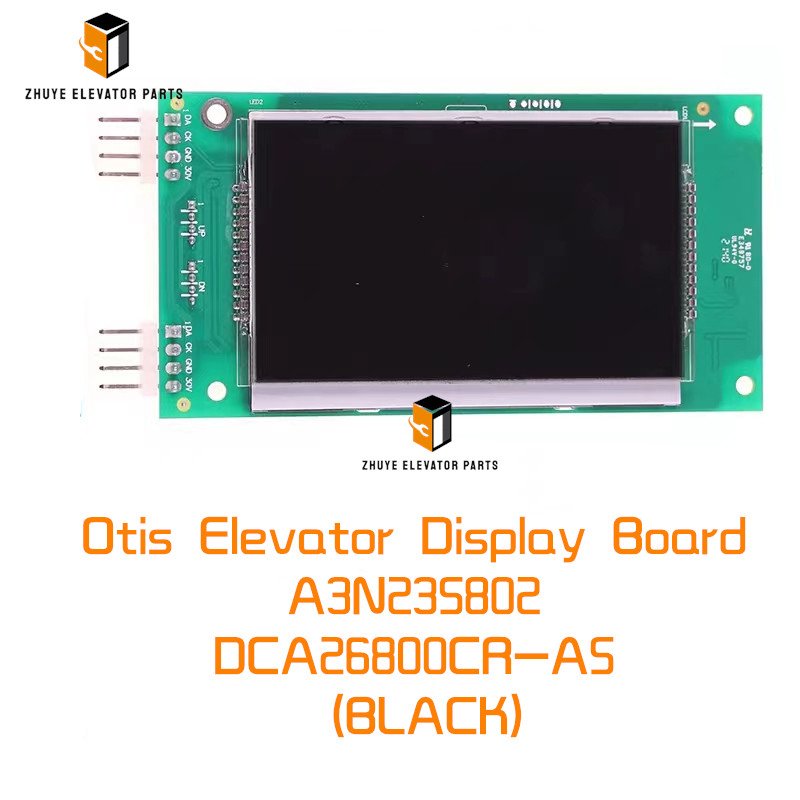
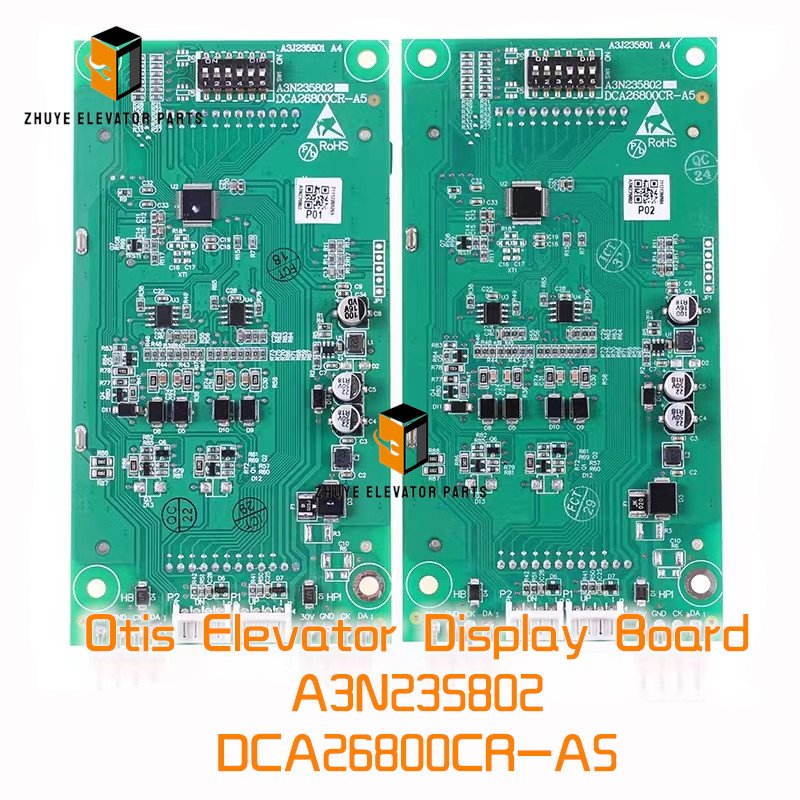
Description
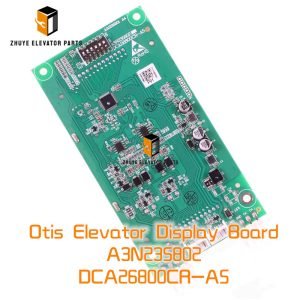
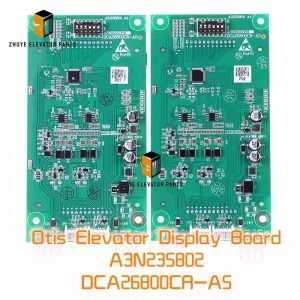
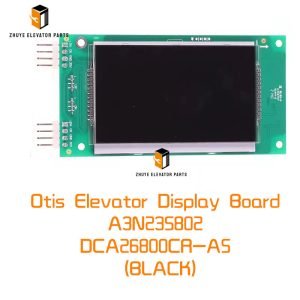
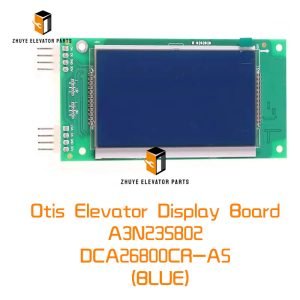
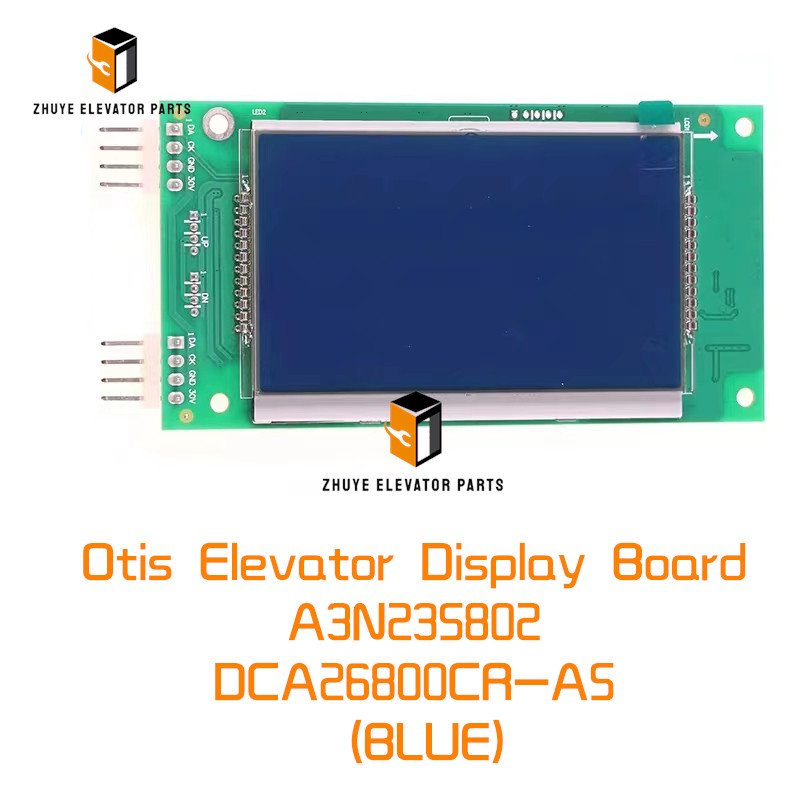
Otis Elevator A3N235802 Display Board DCA26800CR-A5 Brief Introduction
|
Product Name |
Otis Elevator Display Board |
| Model Number | A3N235802
DCA26800CR-A5 |
|
Quality
|
Original.Brand New
|
|
Payment
|
T/T. Paypal. Western Union
|
|
Delivery
|
3-5 Working Days
|
|
Packaging
|
Packed by carton
|
Nanjing Zhuye Elevator Parts – Otis Display Board DCA26800CR-A5 A3N235802: Installation, Calibration & Replacement Guide
The first thing every passenger sees is the floor number glowing behind smoked acrylic. That 4-digit, 7-segment display is driven by Otis board DCA26800CR-A5 (factory code A3N235802), a 24 VDC serial-addressed PCB that also manages direction arrows, gong pulse and fire-service LED. Nanjing Zhuye Elevator Parts has supplied 100 % functional-tested DCA boards since 2012, keeping Sigma, Gen2-MO and XAA controllers legible in 92 countries. Below we explain how to fit, configure and—crucially—when to retire this seemingly “passive” component.
-
Pre-installation safety & ESD protocol
Power down the controller, lock-tag the main breaker and wait 60 s for the 24 VDC rail to fall below 5 V. The board uses CMOS latches vulnerable to 30 V static; keep it in the metallised bag until mounted. Ground your wrist strap to the controller PE bar—not the door sheet metal—to avoid ground loops that ghost segments. -
Physical mounting
DCA26800CR-A5 snaps onto 4 × 6 mm plastic stand-offs inside the COP or LOP can. Verify stand-off height: 15 mm for 9 mm acrylic, 18 mm for 12 mm glass. Wrong height creates parallax shadows and “bleeding” digits. Use only the original M3 × 8 mm screws; longer screws bottom out and crack the 4-layer PCB. Torque to 0.4 N·m—over-tightening warps the board and opens micro-vias. -
Connector map (print and tape inside can)
J1 – 24 VDC input (pin 1 = +24 V, pin 2 = 0 V, pin 3 = chassis GND)
J2 – RS-485 A/B (9600 baud, 8-N-1) address set by DIP 1-4
J3 – Segment output (34-pin ribbon, 1A per common anode)
J4 – Arrow & voice sync (open-collector, 24 V, 50 mA max)
J5 – Fire-service override (active low, 4.7 kΩ pull-up)
J6 – External gong relay (24 V, 0.5 A fuse on-board) -
Addressing & software handshake
Otis controllers auto-scan COP/LOP boards at power-up. Set binary address 0001 for main COP, 0010 for rear COP, 0011–1100 for LOPs. If two boards share the same address, the controller alternates between them, causing flicker every 3 s. After addressing, cycle 24 VDC; the green “COMM” LED should blink once every 2 s—steady on means address collision, off means no RS-485 bias voltage (120 Ω termination missing). Nanjing Zhuye ships each board with a 120 Ω resistor already soldered across J2; verify jumper JP1 is closed only on the last board in the chain. -
Brightness & colour temperature calibration
Out-of-box current is 20 mA per segment, optimised for 9 mm red acrylic. For blue or white filters, change R11 (SMD 1206) from 30 Ω to 47 Ω to avoid wash-out. Use a lux-meter 1 m straight-on: target 45 cd/m² for office, 70 cd/m² for outdoor lobby. Adjust potentiometer VR1 clockwise increases brightness 15 %; beyond that the onboard LM2596 overheats and triggers thermal shutdown. -
Cycle-based life model
The display itself has no moving parts, but LED phosphor degrades and electrolytic capacitors dry out. Nanjing Zhuye accelerated-life data at 85 °C/85 % RH shows 50 000 h until luminance falls to 70 % (L70). Convert hours to elevator cycles:
Light traffic (residence, 60 trips/day, 30 s door open per trip) – 60 × 365 × 0.5 h = 10 950 h/year → replace ≈ 4.5 years.
Medium traffic (hotel, 250 trips/day) – 45 000 h/year → replace ≈ 13 months.
Heavy traffic (metro, 1 200 trips/day) – 219 000 h/year → replace every 6 months, or when luminance < 50 cd/m². -
Preventive inspection schedule
Monthly: glance check for missing segments or ghost arrows.
Quarterly: measure 24 VDC ripple at J1; >1 Vpp indicates supply fatigue, not board fault.
Annually: photograph the display from the same spot; compare RGB values in Photoshop—>15 % drop in red channel predicts imminent L70 failure.
Bi-annually: open can and inspect C1 (100 µF, 35 V) for bulging; ESR > 2 Ω means order the Nanjing Zhuye capacitor kit (NY-DCA-CAP-3PCS) and change on site. -
Replacement procedure (average 8 min)
a) Power down, tag out.
b) Photograph ribbon orientation before removal.
c) Unsnap PCB, transfer plastic stand-offs if not cracked.
d) Fit new Nanjing Zhuye board, torque screws 0.4 N·m.
e) Restore connectors in order J3→J1→J2 to avoid spark on 24 V rail.
f) Power up, verify address LED blink pattern.
g) Run car to top floor and back, checking direction arrows invert correctly.
h) Log serial number and cycle counter in maintenance book; keep packaging for R2 recycling. -
Common field faults & quick cures
Symptom: random segments flash when motor runs.
Cause: missing 0 V bond between controller PE and COP can.
Fix: run 2.5 mm² green/yellow wire, crimp ring terminal under nearest earth bolt.
Symptom: display blanks above 5th floor.
Cause: RS-485 bias resistor omitted on middle LOP.
Fix: close JP1 on the highest-address board only.
Cause: RS-485 bias resistor omitted on middle LOP.
Fix: close JP1 on the highest-address board only.
Symptom: “88” stays lit during fire-service recall.
Cause: J5 solder bridge to 0 V.
Fix: remove bridge, verify fire input floats at 24 V until activated.
Cause: J5 solder bridge to 0 V.
Fix: remove bridge, verify fire input floats at 24 V until activated.
-
Firmware compatibility matrix
Boards shipped after Jan-2024 carry firmware v4.12, backward-compatible to OCSS 7.8. If your controller runs 7.5 or earlier, flash update file “DCA26800_v412.hex” via RS-485 using the free Nanjing Zhuye FlashTool (Windows 10/11). Flash time 45 s; do not interrupt power or the bootloader must be recovered with a JTAG clip. -
Sustainability & take-back
Nanjing Zhuye offers prepaid UPS labels inside every carton. Returned boards are stripped: gold fingers go to certified refinery, aluminium heat-spreader remelted, LEDs recovered for indium. One recycled board saves 26 kWh compared with virgin mining—enough to power the same elevator for a week.
By treating the DCA26800CR-A5 as a safety-critical HMI rather than a commodity light bulb, you eliminate passenger confusion, reduce nuisance callbacks and keep the elevator’s “face” bright, clear and reliable for years. Specify Nanjing Zhuye genuine boards, follow the cycle-based replacement table above, and the only message your passengers will ever read is the one you intend: “Welcome, we’re on our way.”