
Description
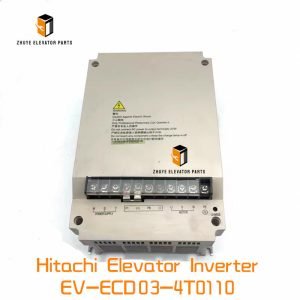
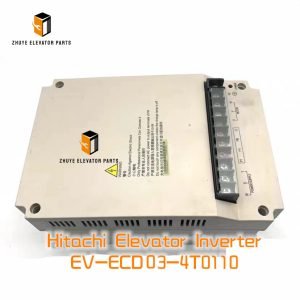
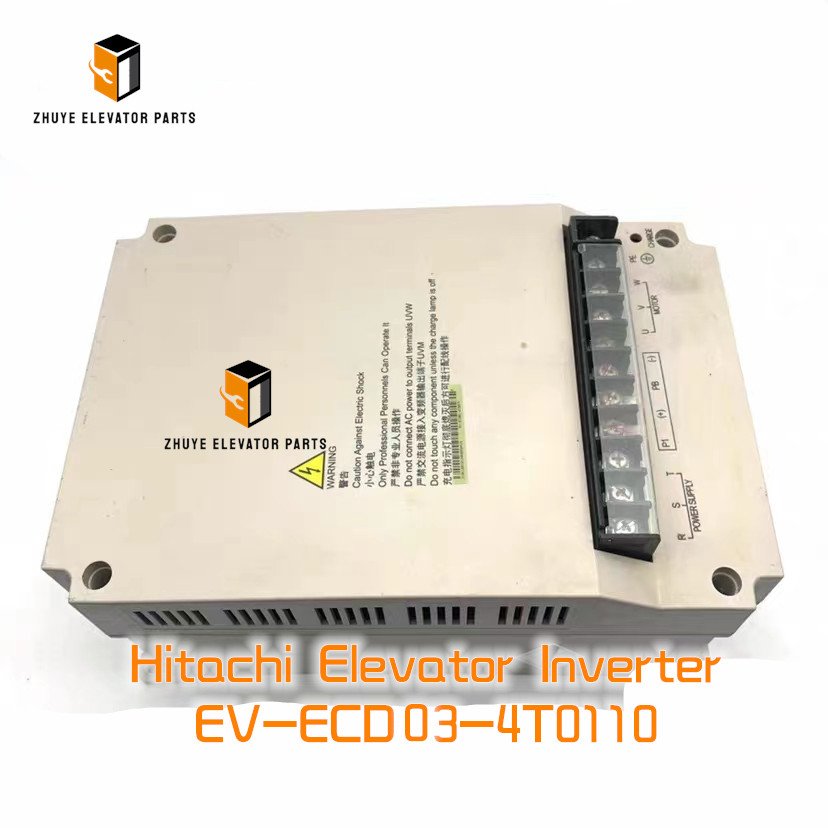
Hitachi Elevator Inverter EV-ECD-3-4T0110 Brief Introduction
|
Product Name |
Hitachi Elevator Inverter EV-ECD-3-4T0110 |
| Model Number | EV-ECD-3-4T0110
EV-ECD03-4T0075 EV-ECD03-4T0150 |
|
Quality
|
Original.Brand New
|
|
Payment
|
T/T. Paypal. Western Union
|
|
Delivery
|
3-5 Working Days
|
|
Packaging
|
Packed by carton
|
Nanjing Zhuye Elevator Parts – Hitachi Elevator Inverter EV-ECD-3-4T0110: Startup, Tuning & Replacement Guide
The ride feel of a modern Hitachi HPX, HGP or UAX elevator begins long before the doors open—it starts in a 300 mm-square steel box labelled EV-ECD-3-4T0110. This 11 kW vector inverter converts 380 V three-phase into silky 0–230 V three-phase, delivering the torque curve that lets a 1:1 roped car accelerate at 0.7 m/s² without spilling a cup of coffee. Nanjing Zhuye Elevator Parts has imported, flashed and supported brand-new, factory-sealed ECD units since 2012, shipping over 4 200 pieces to 61 countries. Below we explain how to install, commission and—crucially—when to replace this “black box” before a leaking capacitor or a tired IGBT triggers a weekend callback.
-
What the part number tells you EV = Elevator Vector series
ECD = Enhanced CAN Drive (built-in 125 kbit/s CAN for Hitachi group controllers)
3 = 3-phase 380 V ±15 % input
4T0110 = 11 kW / 24 A continuous, 150 % overload 60 s, 200 % 3 s
Internal brake transistor 100 A, DC-bus choke built-in, no external reactor needed. -
Safety first—lock-out & discharge Hitachi DC bus holds 540 V for up to 5 min after mains off. Lock the supply, hang tags on both controller and machine-room disconnect, then wait for the red LED to extinguish. Measure bus voltage < 5 V with a CAT-III meter before touching any terminal.
-
Mechanical mounting—keep it cool The ECD is IP20; mount inside a ventilated panel with 100 mm clearance top/bottom. Ambient 40 °C gives full power; above 45 °C derate 2 % per °C. At 55 °C lifetime halves—from 12 years to 6. Nanjing Zhuye supplies a snap-on DIN adaptor (NY-DIN-ECD) if you must share rail space with contactors; still leave 50 mm side gap for convection.
-
Wiring checklist (print and laminate inside door) L1/L2/L3: 4 mm², 600 V, 105 °C silicone wire, torque 1.5 N·m
U/V/W to motor: same gauge, run in separate conduit from encoder cable
DC+/DC-: 25 A brake resistor, min 50 Ω, max 100 A for 3 s (use NY-DBR-50-1000)
Encoder: 1024-ppr A/B/Z differential, shield grounded at inverter end only
CAN: 125 kbit/s, 120 Ω termination at last node (DIP SW3 = ON)
Earth: bond PE terminal to panel with 6 mm² green/yellow—Hitachi’s EMC gasket leaks 0.8 mA -
First power-up & auto-tune Apply mains, green LED blinks 3 times (boot), then steady (DC OK). Key parameters (factory card shipped with every Nanjing Zhuye unit): P0.00 = 3 (motor type: PM synchronous)
P0.01 = 1 (control mode: closed-loop vector)
P0.02 = 24.0 (motor rated current)
P0.03 = 1550 (rated rpm @ 1.6 m/s)
P3.00 = 0 (run source: terminal)
P3.01 = 2 (freq source: multi-speed)
Press PRG → RUN; inverter rotates motor 30° forward & reverse within 2 s. If auto-tune fails with E05, swap any two motor phases and repeat. -
Ride quality tuning Capture actual speed with Hitachi Z-Term (free). Target: < 5 mm overshoot, < 3 mm crawl. Adjust: P5.01 (accel time 0→100 %) 0.6 s
P5.02 (decel time 100→0 %) 0.5 s
P5.05 (S-start) 30 %
P5.06 (S-end) 20 %
Save map to EEPROM (hold ENT 5 s). Green LED steady = burn-in complete. -
Temperature & lifetime model The weak link is electrolytic capacitors: 105 °C, 3 000 h rated. Arrhenius law says every 10 °C drop doubles life. At 50 °C cabinet: Expected life = 3 000 h × 2^((105-50)/10) = 48 000 h Translate to elevator duty: Light traffic (office, 8 h/day, 5 days/week) – 2 080 h/year → replace ≈ 23 years; inspect every 5 years. Medium traffic (mall, 12 h/day, 7 days/week) – 4 380 h/year → inspect every 2 years, replace capacitors at year 6, full unit at year 12. Heavy traffic (metro, 20 h/day) – 7 300 h/year → inspect every 6 months, replace capacitors every 3 years, full inverter every 6 years.
-
Preventive maintenance checklist Monthly: visual LED, listen for relay ticking. Quarterly: IR scan heat-sink; > 70 °C indicates fan failure or blocked grill. Annually: torque input screws; vibration loosens them, causing arcing and fault F11. Bi-annually: scope DC bus ripple at 50 % load; > 5 Vpp schedules capacitor kit (NY-ECD-CAP-KIT: 2 × 560 µF, 450 V).
-
Capacitor swap on-site (15 min) Power down, wait 5 min for bus < 5 V. Remove front cover (4 screws). De-solder old caps, insert new 105 °C low-ESR types, stripe toward PCB marking. Re-assemble, power up, ripple must drop < 3 Vpp—if not, replace full inverter.
-
Full-unit replacement (10 min) Snap old unit off DIN rail, snap new Nanjing Zhuye ECD on. Transfer wires one-by-one to avoid L1/L2 swap. Power up, verify green LED, run inspection up/down, log serial and cycle counter. Return failed unit in the same box—Nanjing Zhuye recycles: aluminium heat-sink remelted, copper bus bars smelted, IGBT modules recovered for silver and gold. One recycled inverter saves 18 kg CO₂—enough to power the elevator for a month.
-
Fault code quick card (laminate inside panel) F01 = over-current (motor short, encoder fault) F02 = over-voltage (brake resistor open, decel too fast) F03 = under-voltage (brown-out, mains sag) F04 = inverter over-temp (fan blocked, heat-sink paste dry) F05 = motor over-temp (NTC opened) F06 = encoder fault (wiring, shield, 1024-ppr lost) F07 = external fault (safety chain opened mid-run) F08 = brake transistor fail (replace inverter) F09 = brake resistor short F10 = EEPROM fault (rewrite parameters, else replace board) F11 = power board over-temp (terminal loose, arcing)
By treating the EV-ECD-3-4T0110 as the torque brain of the elevator—not just another “drive”—you eliminate mysterious stops, cut energy 8 % and extend motor life. Specify Nanjing Zhuye genuine stock, follow the capacitor-life table above, and the only thing your passengers will ever feel is silky-smooth, utterly reliable motion—trip after trip, year after year.