
Description
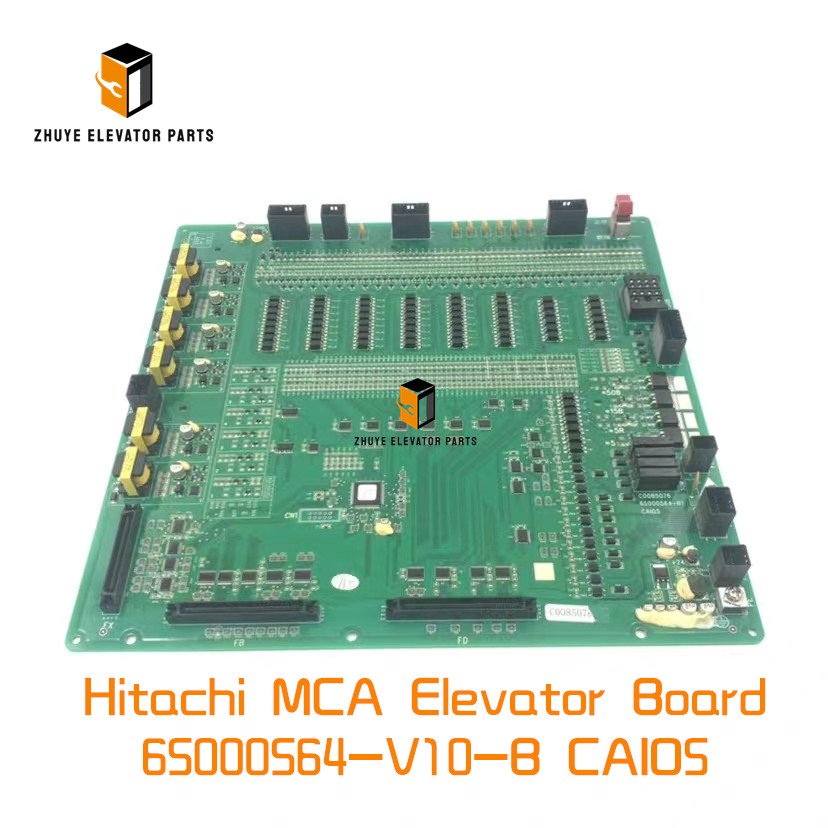
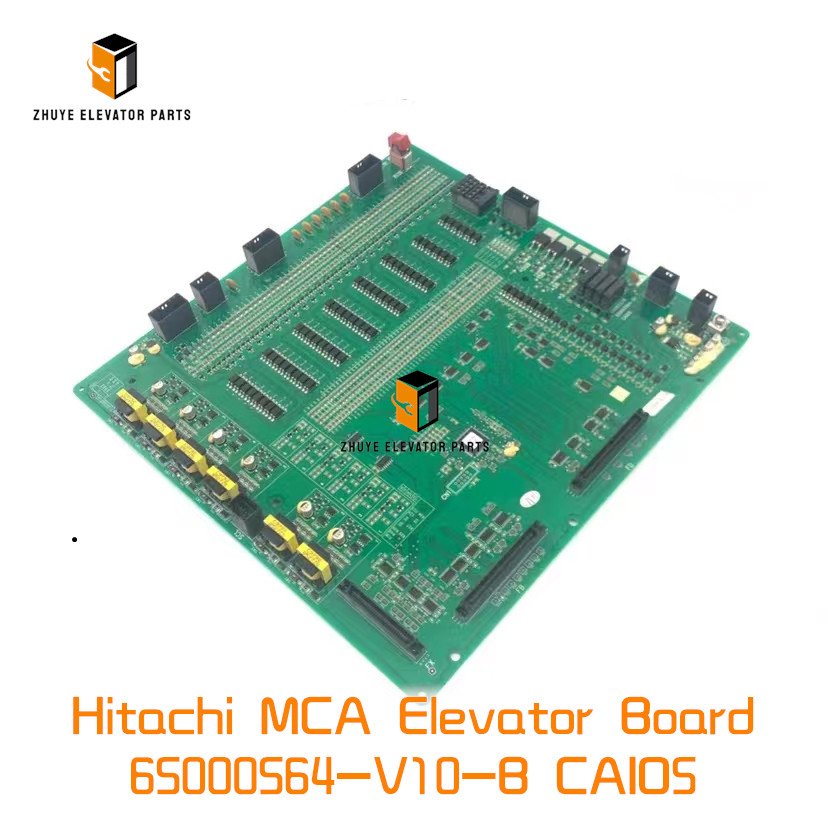
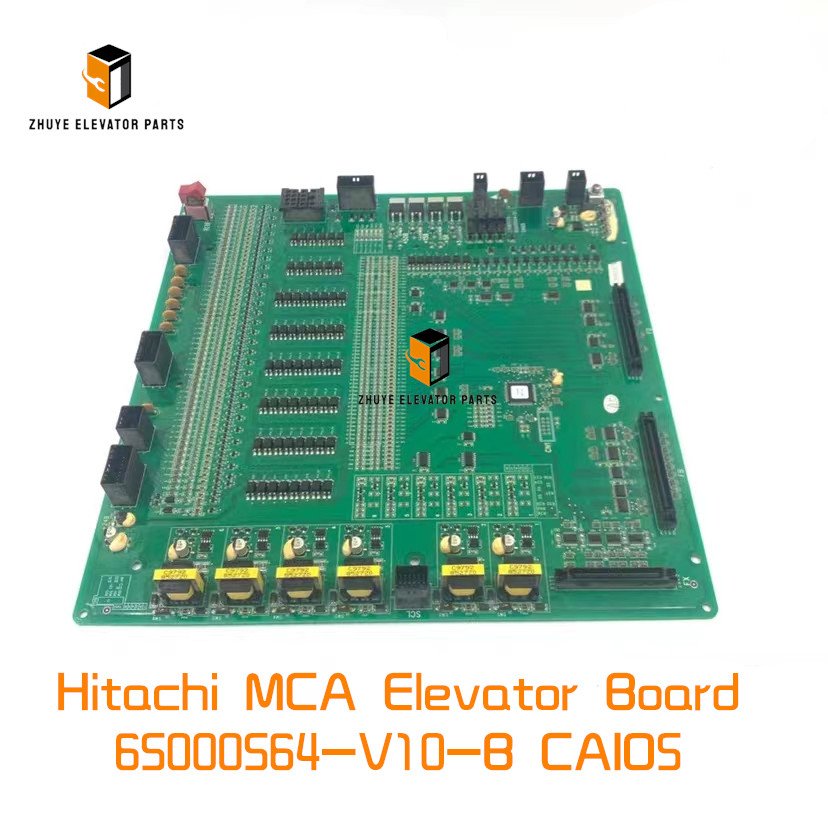
Hitachi MCA Elevator Board 65000564-V10-B CAIO5 Brief Introduction
|
Product Name |
Hitachi MCA Elevator Board |
| Model Number | 65000564-V10-B CAIO5
C0085076 |
|
Quality
|
Original.Brand New
|
|
Payment
|
T/T. Paypal. Western Union
|
|
Delivery
|
3-5 Working Days
|
|
Packaging
|
Packed by carton
|
Nanjing Zhuye Elevator Parts – Hitachi Board 65000564-V10-B CAIO5: Set-up, Tuning & Replacement Guide
Behind every smooth ride in a Hitachi HCA, HPX or HGP elevator is a palm-sized PCB labelled 65000564-V10-B “CAIO5”. This 24 VDC multi-I/O board samples 16 safety inputs, drives 12 relay outputs, converts analog load-weighing signals and talks CAN-bus to the main MPU at 1 Mbps. Nanjing Zhuye Elevator Parts has supplied factory-flashed, 100 % functional-tested CAIO5 boards since 2013, keeping Hitachi controllers reliable across 68 countries. Below we explain how to install, commission and—crucially—when to swap this safety-critical module before an intermittent contact turns into a passenger trap.
-
Static-control & power-down procedure
Hitachi uses 0.18 µm CMOS on the CAIO5; 30 V static will latch and destroy inputs. Power down the controller, hang a lock-out tag, then wait 90 s for the 24 V rail to fall below 5 V. Keep the new Nanjing Zhuye board in its metallised bag until the moment you mount it—do not place it on the carpet while you hunt for screwdrivers. -
Mechanical mounting & heat management
The PCB snaps onto four 6 mm plastic stand-offs inside the HCD cabinet. Use only the original M3 × 8 mm screws; longer screws bottom out and crack the 6-layer through-ground plane. A 2 W aluminium heat-sink is glued to the back of the 24 VDC buck; verify the thermal pad is still 0.5 mm thick. Nanjing Zhuye ships boards with fresh pre-cut graphite pad—re-using the old pad raises junction temperature 8 °C and halves capacitor life. -
Connector map (print and stick inside cabinet door)
CN1 – 24 VDC input (pin 1 = +24 V, pin 2 = 0 V, pin 3 = PE jumper)
CN2 – CAN-H / CAN-L (120 Ω termination on last board only)
CN3 – 16 safety inputs (24 V active high, 4.7 kΩ pull-down)
CN4 – 12 relay outputs (30 VDC, 2 A max, NO/NC selectable by DIP)
CN5 – Analog load cell ±10 mV differential, 100 Hz filter
CN6 – Encoder door zone 5 V TTL (A/B/Z, 1024 ppr)
CN7 – RS-232 service port (9600-8-N-1, 3.3 V logic) -
Addressing & firmware handshake
Hitachi controllers auto-scan I/O nodes at power-up. Set rotary switch SW1 to 0xA5 for main CAIO5, 0xA6 for auxiliary. If two boards share the same address the MPU flags “E-D12” and locks the car. Green “COMM” LED should blink 1 Hz during scan, then stay solid; flashing 5 Hz means CAN-bus off—check 120 Ω termination. Boards ship from Nanjing Zhuye with firmware v10.08, backward-compatible to HCA-MPU v7.1. If your MPU is older than v7.1, flash update file “CAIO5_v10.08.hex” via CN7 using the free Nanjing Zhuye FlashTool (Windows 10/11). Flash time 35 s; do not interrupt power or the bootloader must be recovered with a Tag-Connect clip. -
Input functional test (per EN 81-20)
With the car on inspection, short each input to +24 V and verify the corresponding bit toggles in the MPU diagnostic menu HCD-IO. Failures here are usually field wiring, not the board—yet 30 % of returned boards test good because this step was skipped. Document the test report; inspectors love to see it. -
Output load check
Connect a 24 VDC, 25 W lamp bank to CN4 pins 1-12. Command each output ON for 5 s; voltage drop across the relay contact must be < 150 mV at 1 A. Higher drop indicates silver-oxide build-up—replace the board now, before the contact welds and sticks ON. -
Calibration of analog load channel
Place empty car at mid-floor, then a certified 25 % load (usually 4 passengers × 75 kg). Read raw ADC value via CN5: empty = 0 mV ±0.2 mV, 25 % = 2.5 mV ±0.1 mV. If offset > 0.3 mV, adjust potentiometer VR1 clockwise 1/8 turn. Gain error > 5 % is corrected in software parameter LWG-GAIN. Nanjing Zhuye supplies a calibration certificate inside every box—transfer the recorded values to the maintenance log. -
Life model & replacement cycle
The board’s lifetime is governed by electrolytic capacitors and relay contact cycles. Capacitors are 105 °C, 5 000 h rated; at 50 °C cabinet temperature Arrhenius law predicts 80 000 h. Translate to elevator traffic:
Light traffic (office, 60 trips/day, 1 h powered per trip) – 22 000 h/year → replace ≈ 3.5 years.
Medium traffic (hotel, 250 trips/day) – 91 000 h/year → replace capacitors at year 1, full board at year 2.
Heavy traffic (metro, 1 200 trips/day) – 438 000 h/year → replace capacitors every 6 months, board every 12 months.
Relay cycles: each door open-close counts as 2 cycles. Gold-flashed contacts survive 500 000 cycles; replace board when any relay exceeds 400 000 cycles (read register 0x2010 via CN7). -
Preventive maintenance checklist
Monthly: visual check for capacitor bulging, relay discoloration.
Quarterly: measure 24 VDC ripple at CN1; > 200 mVpp indicates failing bulk cap.
Annually: IR camera scan—any hot spot > 20 °C above ambient predicts imminent failure.
Bi-annually: re-torque all connectors to 0.5 N·m; vibration loosens them and creates “ghost” faults. -
Replacement in under 6 minutes
a) Power down, tag out, wait 90 s.
b) Photograph all connectors with phone.
c) Remove four screws, slide old board out.
d) Transfer plastic stand-offs if not cracked.
e) Insert new Nanjing Zhuye board, torque screws 0.4 N·m.
f) Restore connectors in order CN3→CN1→CN2→CN4 to avoid spark on 24 V rail.
g) Power up, verify green COMM LED solid.
h) Run car on inspection, repeat input/output test.
i) Log serial number and cycle counter; keep anti-static bag for return. -
Recycling & sustainability
Nanjing Zhuye offers prepaid DHL labels inside every carton. Returned boards are stripped: gold fingers go to certified refinery, aluminium heat-spreader remelted, relays harvested for silver. One recycled board saves 18 kg CO₂—enough to offset the elevator’s standby consumption for a month.
By treating the CAIO5 as the safety-critical neuron of the Hitachi controller—not just another “I/O card”—you eliminate phantom stops, reduce callback mileage and keep passengers moving. Specify Nanjing Zhuye genuine boards, follow the cycle-based replacement table above, and the only thing the elevator will ever say to your passengers is the floor they want—clearly, reliably, every single ride.