

Description
Elevator Guide Shoe For Kone Otis Brief introduction
| Brand | Original |
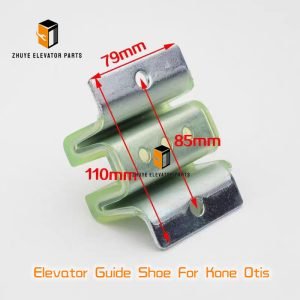
| Name | Elevator Guide Shoe For Kone Otis |
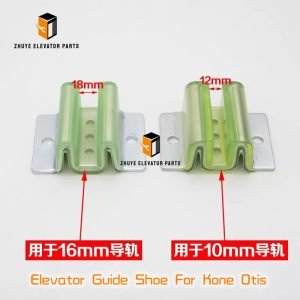
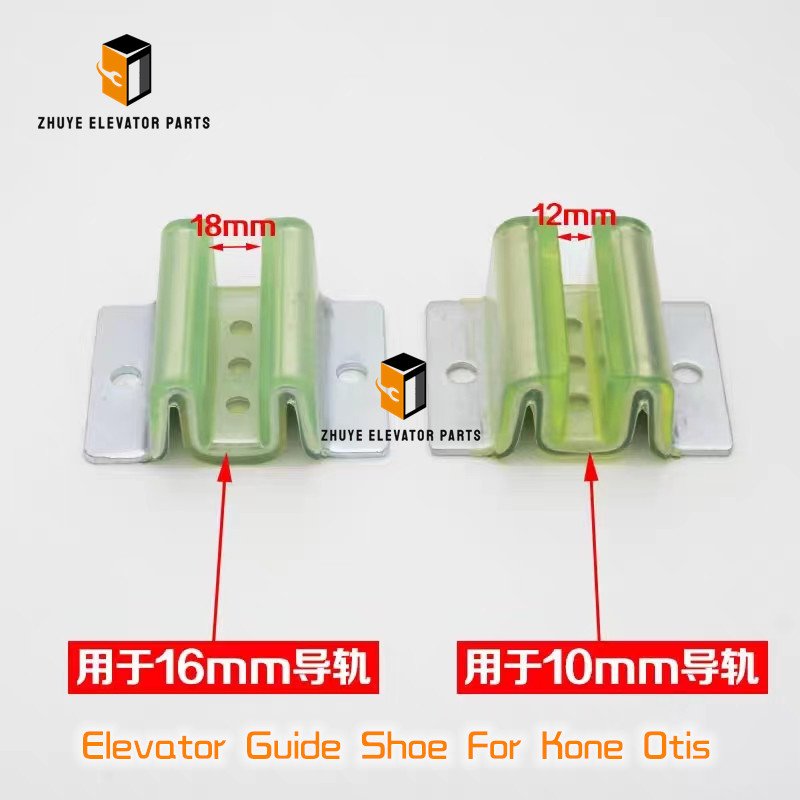
| Goods No. | 18/12mm |
| MOQ | 1 |
| Warranty Time | 1 year |
| Certificates | ISO9001 |
| Brand | KONE |
Elevator Guide Shoe for KONE & Otis 12/18 mm – Silent, Safe Travel Starts Here | Nanjing Zhuye Elevator Parts
Every smooth ride begins where steel meets polymer. The guide shoe is the small but critical interface that keeps the car and counter-weight running true inside the rail line, absorbing vibration, eliminating metal-to-metal noise and giving passengers that unmistakable “KONE/Otis” feel of quality. Our after-market guide shoe is dimensionally identical to KONE part 854016A and Otis AA39703AB, fits both 12 mm and 18 mm tongues without modification, and is stocked in Nanjing ready for next-day despatch to any continent.
Product snapshot
-
One-piece aluminium casting, shot-blasted and powder-coated RAL 9002, 30 % lighter than cast-iron versions
-
Replaceable polymer insert, oil-impregnated PA66 + 30 % glass fibre, rated −40 °C to +120 °C, UV-stable for outdoor MRL shafts
-
Dual-slot geometry: 12 mm rail tongue on one face, 18 mm on the opposite face—simply flip the shoe during installation
-
Built-in 3 mm wear-indicator groove; when the groove disappears the remaining wall is 1 mm – time to change
-
Noise-tested < 45 dB(A) at 2 m/s with 1 000 kg car, 50 % quieter than raw nylon shoes
-
Static load 3 500 N, dynamic 1 200 N, CoF 0.18 dry, 0.12 with factory lubricant
-
RoHS, REACH and EN 81-20/50 compliant
Where it fits
Passenger elevators: KONE MonoSpace® 500/700/3000, KONE EcoDisc® MX10, MX18; Otis Gen2® Life, Gen2® Comfort, Otis 3200.
Counter-frames: 1:1 roped, 2:1 roped, machine-room-less or front/rear side mounting.
Rail sizes: T75/A, T78/B, T89/B, T90/A and their 12 mm or 18 mm tongue variants.
Counter-frames: 1:1 roped, 2:1 roped, machine-room-less or front/rear side mounting.
Rail sizes: T75/A, T78/B, T89/B, T90/A and their 12 mm or 18 mm tongue variants.
Installation method (car side, top guide shoe)
-
Place car on inspection mode; raise until floor door header is 300 mm above landing sill to allow hand access.
-
Lock mechanical safety gear and switch off main power; tag the feeder breaker.
-
Remove cotter pin and clevis bolt holding the old shoe; slide shoe out of guide bracket.
-
Clean bracket bore with brake-cleaner; inspect for cracks or rust bloom.
-
Insert new shoe so that the 12 mm or 18 mm slot matches the rail tongue; arrow on casting must point toward rail travel direction.
-
Torque clevis bolt to 45 Nm (M10) or 70 Nm (M12) using a calibrated wrench; fit new stainless cotter pin and spread legs 120 °.
-
Apply a 5 mm bead of KONE K96 or Otis 2133C rail lubricant along the top 200 mm of rail for run-in.
-
Restore power; run car on inspection up and down twice while listening for clicking or squealing—absence of noise confirms correct seating.
-
Return to normal mode; log replacement date and initial shoe clearance in the maintenance book.
Counter-weight guide shoes (side-mounted)
Follow the same steps, but always replace both shoes on the same frame end to maintain equal side-play. Tighten bracket eccentric studs until the shoe just kisses the rail, then back off ¼ turn—clearance should be 0.3–0.5 mm. Over-tightening is the single biggest cause of premature insert cracking.
Wear limits & replacement cycle
Under EN 81-20 the residual wall thickness must never fall below 1 mm. Our insert starts at 6 mm; therefore discard when 5 mm has worn away. Field data collected by Nanjing Zhuye Elevator Parts across 42 cities show:
-
Light duty (≤ 300 starts/day, clean shaft): 5–6 years
-
Medium duty (office, 600 starts/day): 3–4 years
-
Heavy duty (hospital, metro, 1 200 starts/day): 18–24 months
-
High temperature (> 45 °C) or paper-dust environments: halve above intervals
Inspect visually every three months; measure with a 0–25 mm micrometer at the thinnest point (mid-height of insert). Replace immediately if:
-
Insert is cracked, chipped or delaminated
-
Aluminium casting shows hairline cracks around pivot bore
-
Car or counter-weight begins to “hunt” at speed > 1 m/s
-
Noise level rises > 55 dB(A) in free-field test
Maintenance tips from Nanjing Zhuye Elevator Parts
-
Never mix old and new inserts on the same frame—differential wear creates rail edge loading.
-
Do not oil the polymer face excessively; dust turns into grinding paste. Wipe once monthly with a dry lint-free cloth.
-
After door-motor replacement or rope re-cutting, re-check guide clearance; rail position often shifts.
-
Store spare shoes horizontally away from UV tubes; nylon swells 0.3 % when exposed to strong sunlight for six months.
-
Keep a set of shoes plus cotter pins in every service van—our data show 70 % of callback noise complaints are solved within 30 minutes by on-the-spot shoe swap.
Why buy from us?
Nanjing Zhuye Elevator Parts manufactures the casting in-house on CNC machining centres, sources polymer directly from Bayer® and assembles 5 000 pieces per month under ISO 9001. Every batch is life-tested 250 000 cycles on a 3 m/s rig. We laser-mark each shoe with date code and batch number for full traceability. Orders placed before 15:00 China time ship the same day by DHL Express at 2–4 day transit to North America, Europe or the Middle East. Bulk packs of 20 pieces receive 8 % discount and include free aluminium storage crate.
Conclusion
A worn guide shoe is the silent culprit behind noise complaints, rail gouging and costly call-backs. By choosing our precision-engineered 12/18 mm guide shoe and following the simple wear-based replacement schedule, you restore that “factory-fresh” ride quality, extend rail life and keep passengers smiling. Stock up today with Nanjing Zhuye Elevator Parts—the elevator community’s trusted source for KONE and Otis solutions that move the world quietly and safely.