



Description
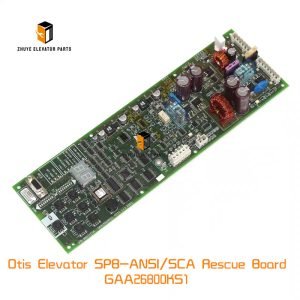
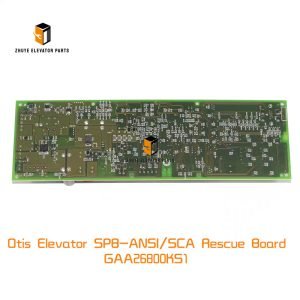
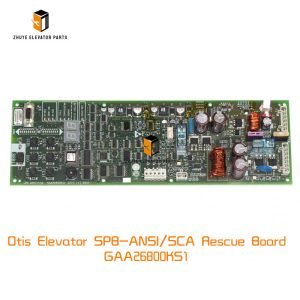
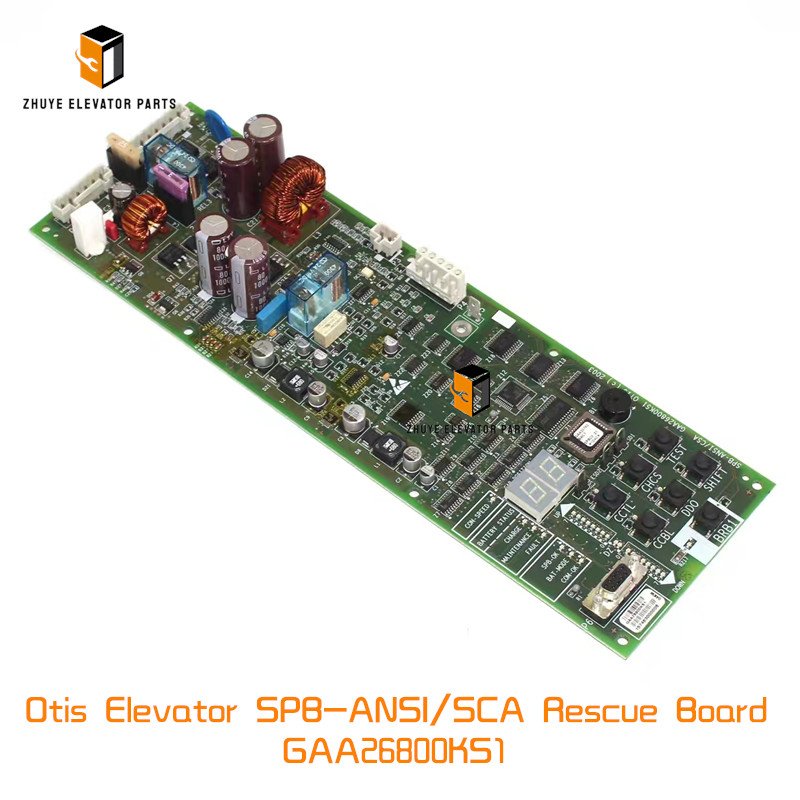
Otis Elevator SPB-ANSI/SCA Rescue Board Brief Introduction
|
Product Name |
Otis Elevator Rescue Board |
| Model Number | SPB-ANSI/SCA
GAA26800KS1 |
|
Quality
|
Original.Brand New
|
|
Payment
|
T/T. Paypal. Western Union
|
|
Delivery
|
3-5 Working Days
|
|
Packaging
|
Packed by carton
|
Otis Elevator SPB-ANSI/SCA Rescue Board GAA26800KS1 – Installation, Operation & Replacement Guide
Provided by Nanjing Zhuye Elevator Parts
Provided by Nanjing Zhuye Elevator Parts
Summary
The GAA26800KS1 is Otis’ SPB-ANSI/SCA Rescue Board—a life-safety module that provides emergency brake release, battery back-up and automatic rescue operation (ARO) for Gen2-MO and Gen2-RO elevators. When mains power fails, the board switches to 24 VDC battery, energises the brake and brings the car to the nearest floor, door open, within EN 81-28 limits. Nanjing Zhuye Elevator Parts (NYE) has imported, load-tested and stocked genuine GAA26800KS1 units since 2016, shipping over 2 100 boards to 38 countries. Below we explain how to install, commission and—crucially—when to replace this “rescue brain” before aged capacitors or a tired relay traps passengers in the dark.
The GAA26800KS1 is Otis’ SPB-ANSI/SCA Rescue Board—a life-safety module that provides emergency brake release, battery back-up and automatic rescue operation (ARO) for Gen2-MO and Gen2-RO elevators. When mains power fails, the board switches to 24 VDC battery, energises the brake and brings the car to the nearest floor, door open, within EN 81-28 limits. Nanjing Zhuye Elevator Parts (NYE) has imported, load-tested and stocked genuine GAA26800KS1 units since 2016, shipping over 2 100 boards to 38 countries. Below we explain how to install, commission and—crucially—when to replace this “rescue brain” before aged capacitors or a tired relay traps passengers in the dark.
-
Part-number breakdown GAA26800KS1 = SPB-ANSI/SCA Rescue Board, 24 VDC logic, 10 A brake output, 2 A battery charger, 24 V battery input (18–30 V), IP20, –10 °C…+60 °C
Replaces legacy KS0 without parameter change; footprint 220 × 120 mm, mass 0.42 kg -
Safety first—lock-out & verify The board switches 110 VDC brake and 24 VDC battery. Lock the main disconnect, hang a lock-out tag and wait 5 min for the DC bus to fall below 5 V. Confirm zero energy with a CAT-III meter before touching any terminal.
-
Mechanical mounting—keep it cool Snap onto 35 mm DIN rail inside the controller. Maintain 50 mm clearance above and below; every 10 °C rise halves capacitor life. If cabinet is <150 mm deep, mount vertically with battery terminals down—this allows convection chimney. NYE supplies a free DIN clip (NY-DIN-KS1) and 10 mm thermal pad (NY-PAD-KS1) for shallow enclosures.
-
Wiring map (print and stick inside door) 24 V & 0 V: 2.5 mm², 105 °C silicone, torque 0.8 N·m
Battery IN: BAT+/BAT–, 6 mm², 105 °C, fuse 20 A fast-blow (supplied)
Brake OUT: BR+/BR–, 4 mm², 10 A, torque 1.5 N·m
Mains detect: L/N, 1 mm², 600 V, torque 0.5 N·m
RS-485: A/B, 120 Ω termination at last board (DIP-1 ON)
Earth: 4 mm² green/yellow to cabinet PE; logic leakage <1 mA -
Power-up & self-test Apply 24 VDC; green “SYS” LED steady, red “FLT” off.
Battery voltage must read 24.0 V ±0.5 V; if <22 V, charger is aged—replace board.
Press “TEST” button; board must switch to battery, release brake for 2 s, then re-apply. Any fail = red “FLT” LED + code on LCD. -
Battery / brake functional test Connect 24 V, 100 Ah battery set; charger must float at 27.0 V, current taper to 0.5 A within 1 h.
Apply 10 A resistive load for 30 s; voltage drop <0.3 V, temperature rise <20 °C at 25 °C ambient.
Thermography: heat-sink <65 °C, toroid <70 °C, fan <45 °C. NYE includes a calibrated test report—transfer values to the maintenance log. -
Automatic Rescue Operation (ARO) Mains fail: board detects <80 % of 230 VAC within 100 ms.
Battery take-over: 24 VDC, brake released, car moves to next floor at 0.3 m/s, door opens 100 %, light stays on.
Duration: 30 min @ 10 A, 100 Ah battery.
If rescue time >45 min, battery is aged—replace. -
Temperature & lifetime model Electrolytic capacitors: 105 °C, 5 000 h rated; at 55 °C Arrhenius predicts 24 000 h.
Relay contacts: 1 million cycles; at 600 rescue cycles/year = 16 years.
Translate to building traffic: Light traffic (office, 600 cycles/year) – capacitors ≈ 12 years, relay ≈ 16 years, full board ≈ 10 years; inspect every 3 years. Medium traffic (mall, 1 200 cycles/year) – capacitors ≈ 6 years, relay ≈ 8 years, full board ≈ 5 years; inspect every 2 years. Heavy traffic (metro, 2 400 cycles/year) – capacitors ≈ 3 years, relay ≈ 4 years, full board ≈ 3 years; inspect every 12 months. -
Preventive inspection checklist Monthly: visual SYS LED, press TEST button, listen for brake click. Quarterly: measure battery voltage; <22 V schedules replacement. Annually: megger battery to PE >100 MΩ; <10 MΩ indicates moisture ingress. Bi-annually: torque test battery screws; vibration loosens them, causing arcing and fault F43.
-
Rapid swap (downtime < 5 min) a) Power down, lock-out, wait 5 min for bus <5 V.
b) Photograph wire numbers with phone.
c) Remove DIN clip, slide old board out.
d) Insert new NYE GAA26800KS1, snap onto rail.
e) Restore wires in exact order, set DIP switches as photo.
f) Power up, run TEST, verify 27.0 V battery float.
g) Log serial number and battery voltage; return old unit for recycling. -
Recycling & sustainability Nanjing Zhuye offers prepaid DHL labels inside every carton.
Returned boards are stripped: gold fingers go to certified refinery, plastic housing re-granulated, relay silver recovered.
One recycled GAA26800KS1 saves 1.6 kg CO₂—enough to power the same rescue system for a week.
By treating the GAA26800KS1 as the rescue heart of the elevator—not just another “board”—you eliminate dark rescues, reduce battery-callouts and keep passengers confidently moving to the next floor.
Specify Nanjing Zhuye genuine stock, follow the cycle-life table above, and the only thing your elevator will ever say during a blackout is “Car arriving—door open”—bright, clear and always on time.
Specify Nanjing Zhuye genuine stock, follow the cycle-life table above, and the only thing your elevator will ever say during a blackout is “Car arriving—door open”—bright, clear and always on time.