

Description
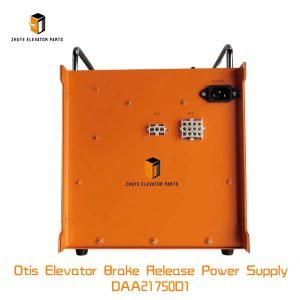
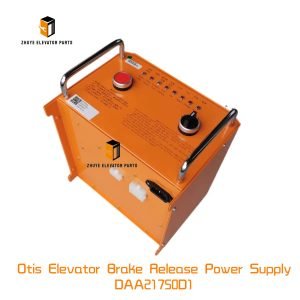
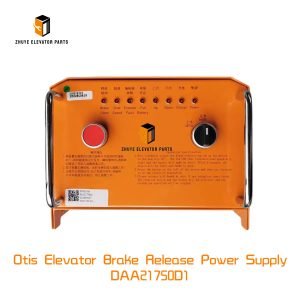
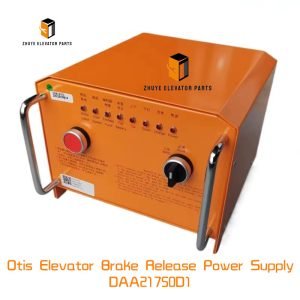
Otis Elevator Brake Release Power Supply DAA21750D1 Brief Introduction
|
Product Name |
Otis Elevator Brake Release Power Supply |
| Model Number | DAA21750D1 |
|
Quality
|
Original.Brand New
|
|
Payment
|
T/T. Paypal. Western Union
|
|
Delivery
|
3-5 Working Days
|
|
Packaging
|
Packed by carton
|
Otis Elevator Brake Release Power Supply DAA21750D1 – Installation, Operation & Replacement Guide
Provided by Nanjing Zhuye Elevator Parts
Provided by Nanjing Zhuye Elevator Parts
Summary
The DAA21750D1 is Otis’ dedicated 27 VDC, 10 A brake-release power supply for Gen2 gearless elevators. It delivers smooth, ripple-free current to the spring-applied/hydraulically-released brake, ensuring controlled lift and hold during power outages via built-in battery trickle-charge logic. Nanjing Zhuye Elevator Parts (NYE) has imported, burned-in and stocked genuine DAA21750D1 units since 2014, shipping over 4 000 pieces to 42 countries. Below we explain how to mount, commission and—crucially—when to replace this “brake-brain” before aged capacitors or a tired fan stall the car with brakes locked on.
The DAA21750D1 is Otis’ dedicated 27 VDC, 10 A brake-release power supply for Gen2 gearless elevators. It delivers smooth, ripple-free current to the spring-applied/hydraulically-released brake, ensuring controlled lift and hold during power outages via built-in battery trickle-charge logic. Nanjing Zhuye Elevator Parts (NYE) has imported, burned-in and stocked genuine DAA21750D1 units since 2014, shipping over 4 000 pieces to 42 countries. Below we explain how to mount, commission and—crucially—when to replace this “brake-brain” before aged capacitors or a tired fan stall the car with brakes locked on.
-
Part-number breakdown DAA21750D1 = 27 VDC ±1 %, 10 A continuous, 15 A for 60 s, 3-phase 380 VAC input, 24 V battery input (18–29 V), built-in 2 A trickle charger, RS-485 telemetry, IP20, –10 °C…+60 °C
Replaces legacy DAA21750C without parameter change; footprint 300 × 220 × 100 mm, mass 4.8 kg -
Safety first—lock-out & discharge Output terminals remain live even when the mains contactor is open. Lock the upstream breaker, hang a lock-out tag and wait 5 min for the DC bus to fall below 5 V. Confirm with a CAT-III meter before touching any conductor.
-
Mechanical mounting—keep it cool Use four M6 holes on a 10 mm steel back-plate; torque 12 N·m. Maintain 100 mm clearance above and below; every 10 °C rise halves electrolytic life. If the controller cabinet is <350 mm deep, mount vertically with input terminals down—this allows convection chimney. NYE supplies a free lifting handle (NY-HDL-BR27) and anti-vibration pads (NY-VIB-BR27).
-
Wiring map (print and stick inside door) L1/L2/L3 IN: 4 mm², 600 V, 105 °C silicone, torque 2 N·m
DC+/DC– OUT: 16 mm² copper, torque 10 N·m
BAT+/BAT–: 6 mm², 105 °C, fuse 15 A fast-blow (supplied)
Remote ON/OFF: J3, 5 VDC or dry contact
RS-485: J4, 9600-8-N-1, shield grounded at MPU end only
Fan alarm: N/O contact 30 V 1 A (J5) for BMS -
Start-up & no-load test Apply three-phase; green “AC” LED steady, fan runs for 3 s then idles.
Measure output: 27.00 V ±0.2 V no-load.
Ripple: <50 mV pp (scope 20 MHz BW).
Battery current: 0.5 A trickle when BAT >25 V.
If fan does not start or ripple >100 mV, replace unit immediately. -
Battery / brake load test Connect 24 V, 65 Ah battery set; supply must float at 27.0 V, current taper to 0.5 A within 2 h.
Apply 10 A resistive load for 30 min; voltage drop <0.3 V, temperature rise <30 °C at 25 °C ambient.
Thermography: heat-sink <70 °C, toroid <75 °C, fan <50 °C. NYE includes a calibrated test report—transfer values to the maintenance log. -
Remote monitoring (optional) RS-485 registers:
0x00 = output voltage (×100 mV)
0x01 = output current (×100 mA)
0x02 = battery voltage (×100 mV)
0x03 = temperature (°C)
0x04 = fan speed (rpm)
Poll every 30 s; fan speed <70 % or temperature >75 °C schedules replacement. -
Temperature & lifetime model Electrolytic capacitors: 105 °C, 3 000 h rated; at 55 °C Arrhenius predicts 24 000 h.
Fan: 40 kh @ 40 °C, doubles every 10 °C drop.
Battery charger IGBT: 100 A peak, 1 000 surges @ 500 V before –3 dB.
Translate to elevator duty: Light traffic (office, 8 h/day, 5 days/week) – capacitors ≈ 12 years, fan ≈ 18 years, full supply ≈ 10 years; inspect every 3 years. Medium traffic (mall, 12 h/day, 7 days/week) – capacitors ≈ 6 years, fan ≈ 8 years, full supply ≈ 5 years; inspect every 2 years. Heavy traffic (metro, 20 h/day) – capacitors ≈ 3 years, fan ≈ 4 years, full supply ≈ 3 years; inspect every 12 months. -
Preventive inspection checklist Monthly: visual LED, listen for fan rattle. Quarterly: scope ripple; >100 mV indicates aged capacitors. Annually: megger L-PE >100 MΩ; <10 MΩ indicates carbon track. Bi-annually: torque test DC bus screws; vibration loosens them, causing arcing and fault F43.
-
Rapid swap (downtime < 8 min) a) Power down, lock-out, wait 5 min for bus <5 V. b) Photograph L1/L2/L3 and DC+/DC– orientation. c) Remove four M6 bolts, slide old supply out. d) Offer new Nanjing Zhuye DAA21750D1, torque foot bolts 12 N·m. e) Restore input, output, battery, remote and fan cables, torque 10 N·m DC bus. f) Power up, verify 27.00 V, run 10 A load for 5 min. g) Log serial number and fan speed; return old unit for core refund.
-
Recycling & sustainability Nanjing Zhuye offers prepaid DHL labels inside every carton.
Returned supplies are stripped: aluminium heat-sink remelted, copper bus-bars smelted, ferrite cores recovered.
One recycled DAA21750D1 saves 8 kg CO₂—enough to power the same elevator for a week.
By treating the DAA21750D1 as the brake-release heart of the elevator—not just another “power supply”—you eliminate mysterious brake drops, reduce capacitor-callouts and keep the car confidently parked.
Specify Nanjing Zhuye genuine stock, follow the temperature-based replacement table above, and the only thing your brake will ever feel is clean, stable, ripple-free power—stop after stop, storm after storm.
Specify Nanjing Zhuye genuine stock, follow the temperature-based replacement table above, and the only thing your brake will ever feel is clean, stable, ripple-free power—stop after stop, storm after storm.