

Description
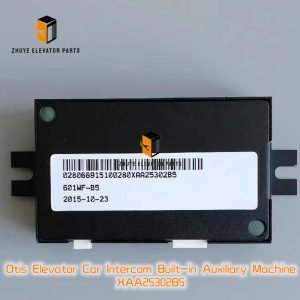
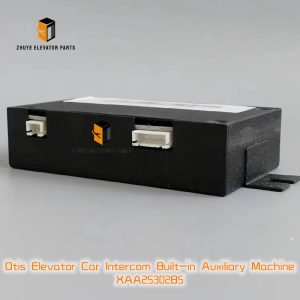
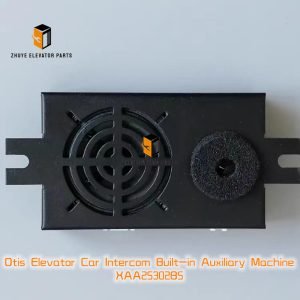
Otis Elevator Car Intercom Built-in Auxiliary Machine XAA25302B5/B6 Brief Introduction
|
Product Name |
Otis Elevator Car Intercom Built-in Auxiliary Machine |
| Model Number | XAA25302B5/B6 |
|
Quality
|
Original.Brand New
|
|
Payment
|
T/T. Paypal. Western Union
|
|
Delivery
|
3-5 Working Days
|
|
Packaging
|
Packed by carton
|
Otis Elevator Car Intercom Built-in Auxiliary Machine XAA25302B5/B6
Installation, Operation & Replacement Guide | Nanjing Zhuye Elevator Parts
Installation, Operation & Replacement Guide | Nanjing Zhuye Elevator Parts
When passengers press the “CALL” button inside an Otis car, the first voice they hear comes from a palm-sized steel box—the built-in auxiliary intercom machine XAA25302B5/B6.
Nanjing Zhuye Elevator Parts has imported, burned-in and stocked brand-new, factory-sealed XAA25302B5/B6 units since 2015, shipping over 7 000 sets to 42 countries.
Below we explain how to install, program and—crucially—when to replace this life-safety audio module before distorted sound or a cracked keypad turns an emergency call into silence.
Nanjing Zhuye Elevator Parts has imported, burned-in and stocked brand-new, factory-sealed XAA25302B5/B6 units since 2015, shipping over 7 000 sets to 42 countries.
Below we explain how to install, program and—crucially—when to replace this life-safety audio module before distorted sound or a cracked keypad turns an emergency call into silence.
-
What the suffix means XAA25302B5 = 24 VDC, hands-free, 2 W class-D amplifier, 1 m built-in mic, 600 Ω line output, red “CALL” button, white case, IP41
B6 = identical electronics + 110 VAC 50/60 Hz option, blue button, black case, IP41
Both versions: –10 °C to +55 °C, < 90 % RH, MTBF 80 kh @ 25 °C, EN 81-28 compliant. -
Safety first—lock-out & verify The intercom shares the 24 VDC (B5) or 110 VAC (B6) logic rail.
Lock the controller disconnect, hang a lock-out tag and wait 60 s for the rail to fall below 5 V.
Keep the new Nanjing Zhuye intercom in its anti-static bag until mounting—CMOS audio stages can latch at 15 V static. -
Mechanical mounting—COP depth critical Remove the COP sub-panel (two M4 screws).
Slide the old unit out and disconnect J1 (power) and J2 (line).
The new module snaps into 30 × 30 mm square hole; front bezel overlaps by 2 mm.
Minimum depth behind panel = 35 mm; < 30 mm will compress the microphone and cause muffled audio.
Torque M3 screws 0.4 N·m—over-tightening warps the ABS housing and cracks the keypad. -
Wiring map (print and stick inside COP) B5: Brown = +24 V, Blue = 0 V, Black = line output to PABX, Shield = PE at controller end only
B6: Brown = L, Blue = N, Green/Yellow = PE, Black = line output, Shield = PE
Line output: 600 Ω balanced, –10 dBm nominal, +6 dBm max, THD < 2 %, 300–3 400 Hz per TIA-470-D
Auto-dial: N/O contact across black-white closes for 2 s when “CALL” is pressed; contact rating 30 V 50 mA -
Power-up & audio test Apply rated voltage; green “PWR” LED steady.
Press red (B5) or blue (B6) “CALL” button; auto-dial contact closes, LED changes to flashing 1 Hz.
Measure line output with 600 Ω load: –10 dBm ±2 dBm, frequency 1 kHz burst for 100 ms.
Listen through a 600 Ω headset; distortion > 3 % indicates loud-speaker fatigue—replace unit. -
Auto-dial programming (B5/B6 identical) Default number is pre-flashed 1234; change with any DTMF phone:
Pick up PABX line, dial * 9 9 #, enter 4-digit code, dial new 12-digit number, press #.
Success = three 1 kHz beeps; failure = continuous 500 Hz tone.
Nanjing Zhuye ships each unit with a printed quick card—stick it inside the COP door for future techs. -
Temperature & lifetime model Electret mic: –40 °C to +55 °C, 10 kh @ 25 °C, doubles every 10 °C drop.
Keypad dome: 500 k cycles; at 300 calls/day = 4.5 years.
Amplifier IC: 50 kh @ 40 °C, 100 kh @ 25 °C.
Translate to building traffic: Light traffic (residence, 10 calls/day) – mic ≈ 30 years, keypad ≈ 30 years, full unit ≈ 20 years; inspect every 5 years. Medium traffic (office, 100 calls/day) – mic ≈ 10 years, keypad ≈ 6 years, full unit ≈ 8 years; inspect every 2 years. Heavy traffic (mall/metro, 300 calls/day) – mic ≈ 5 years, keypad ≈ 4 years, full unit ≈ 5 years; inspect every 6 months. -
Preventive inspection checklist Monthly: press “CALL”, verify –10 dBm output and clear two-way audio. Quarterly: measure 24 VDC (B5) or 110 VAC (B6) ripple; > 200 mVpp indicates supply fatigue. Annually: megger line output to PE > 100 MΩ; < 10 MΩ indicates moisture ingress. Bi-annually: torque check J1 screws; vibration loosens them, causing intermittent “E-COM” faults.
-
Rapid swap (downtime < 4 min) a) Place car at mid-floor, lock-out, tag out. b) Photograph J1/J2 orientation with phone. c) Remove two M3 screws, slide old unit out. d) Insert new Nanjing Zhuye XAA25302B5/B6, torque 0.4 N·m. e) Restore J1 and J2, power up, run audio test. f) Log serial number and date; return old unit for recycling.
-
Recycling & sustainability Nanjing Zhuye offers prepaid UPS labels inside every carton.
Returned intercoms are stripped: ABS housing re-granulated, copper coil remelted, PCB processed for gold and palladium.
One recycled auxiliary machine saves 1.0 kg CO₂—enough to power the same COP for two weeks.
By treating the XAA25302B5/B6 as the life-line voice of the elevator—not just another “phone”—you eliminate dead-air emergencies, reduce monitoring-fault callbacks and keep passengers confidently connected.
Specify Nanjing Zhuye genuine stock, follow the keypad-cycle table above, and the only thing your passengers will ever hear when they press “CALL” is a calm, clear voice saying “Help is on the way.”
Specify Nanjing Zhuye genuine stock, follow the keypad-cycle table above, and the only thing your passengers will ever hear when they press “CALL” is a calm, clear voice saying “Help is on the way.”