Description
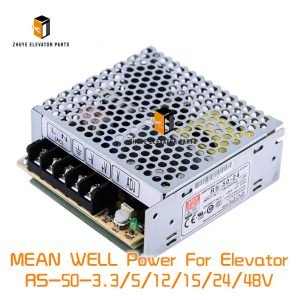
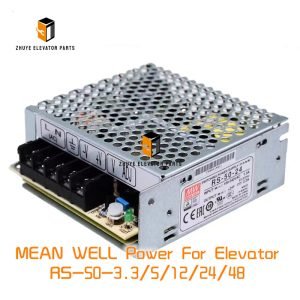
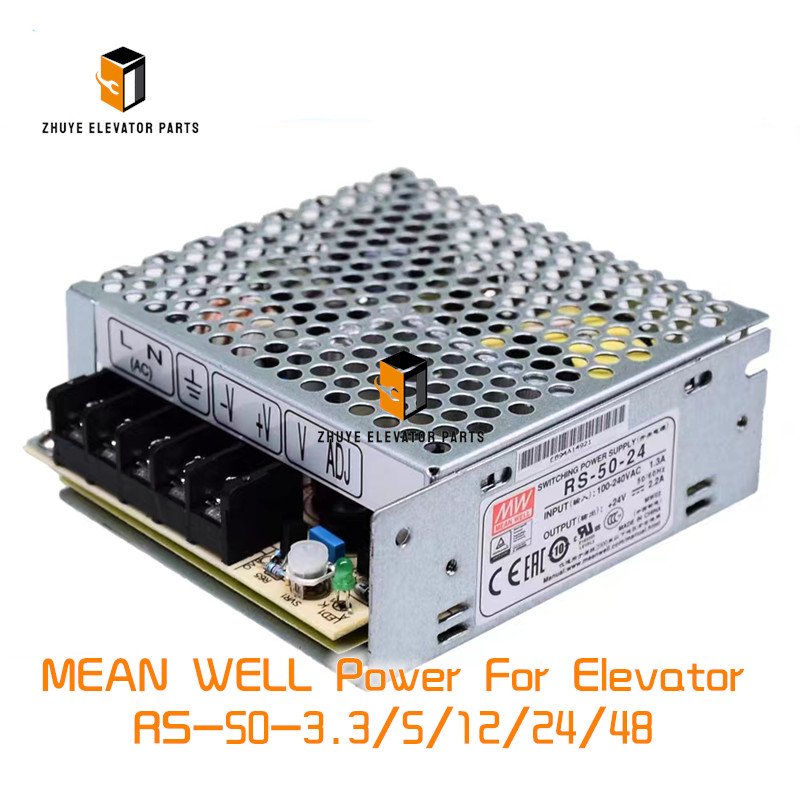
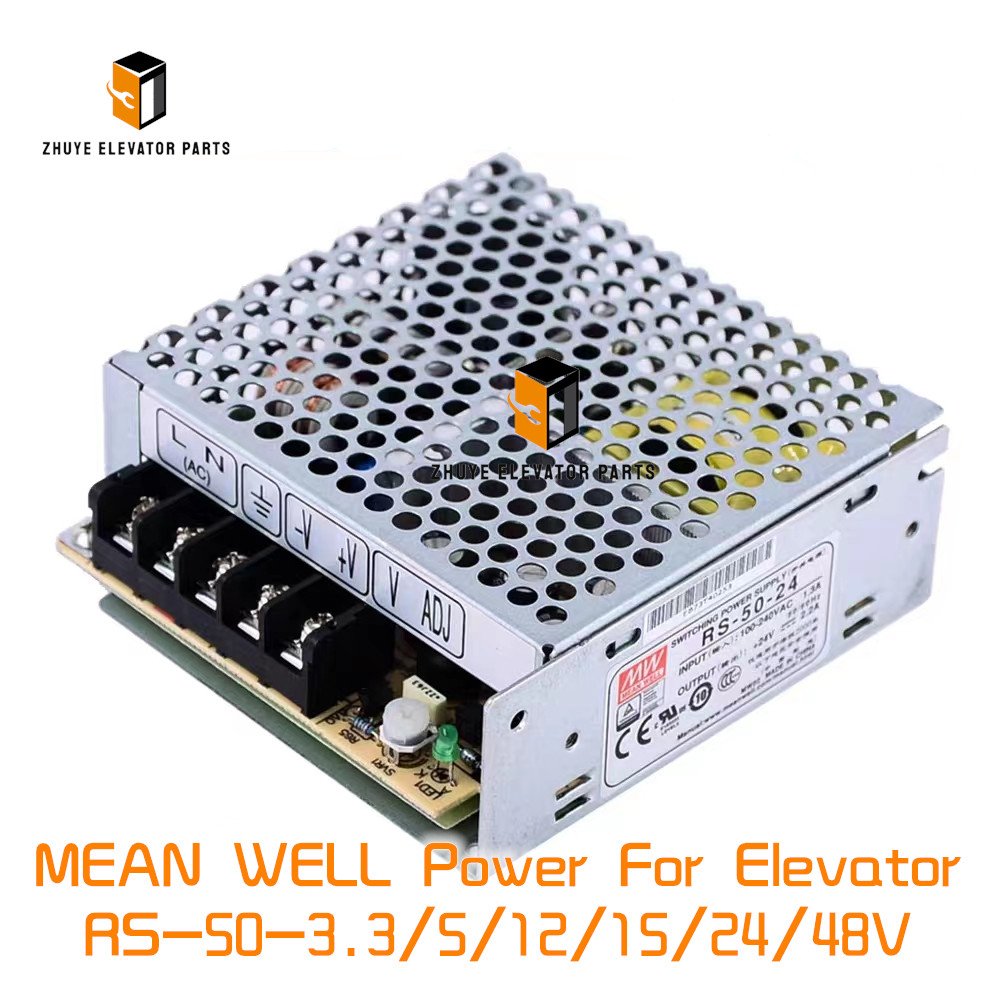
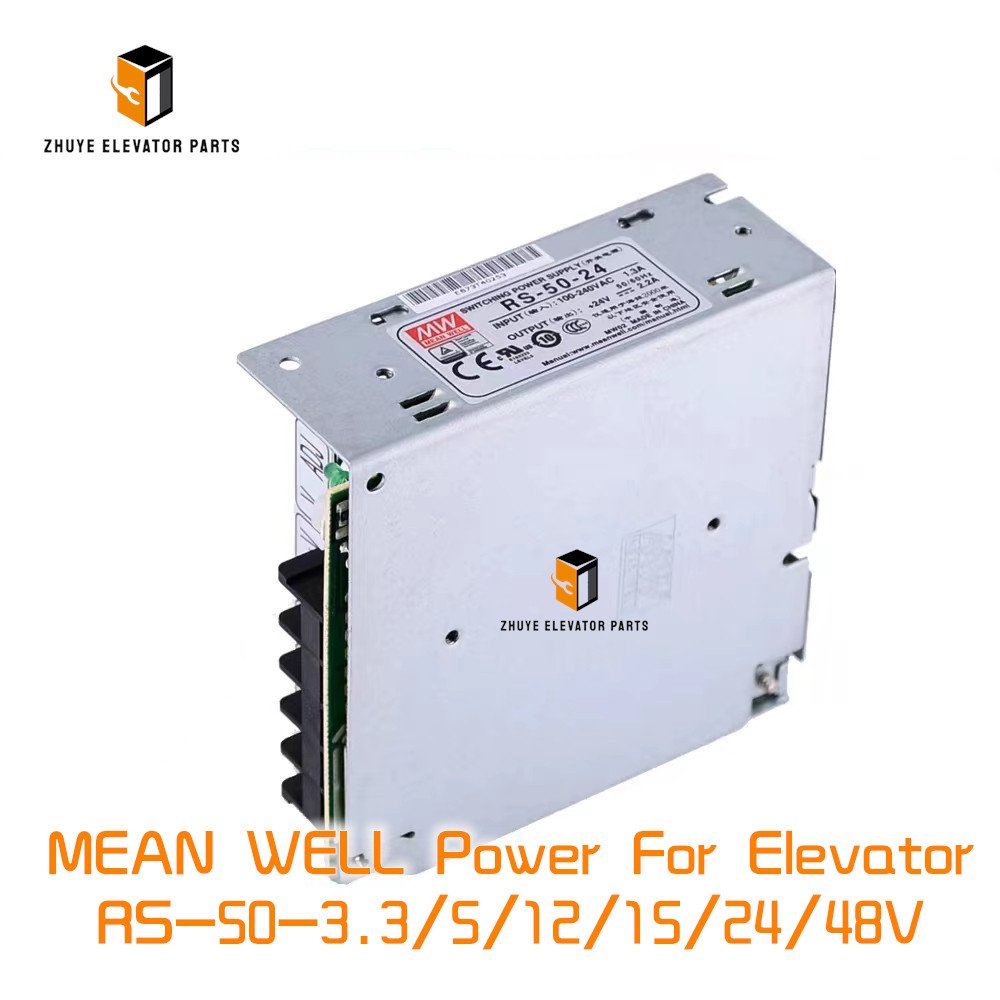
MEAN WELL Power Supply For Elevator RS-50-3.3/5/12/15/24/48V Brief Introduction
|
Product Name |
MEAN WELL Power Supply For Elevator |
| Model Number | RS-50-3.3/5/12/15/24/48V |
|
Quality
|
Original.Brand New
|
|
Payment
|
T/T. Paypal. Western Union
|
|
Delivery
|
3-5 Working Days
|
|
Packaging
|
Packed by carton
|
Nanjing Zhuye Elevator Parts – MEAN WELL RS Series 50 W Power Supply for Elevators: Selection, Installation & Lifetime Guide
From the controller CPU to the COP display, every modern elevator needs a rock-solid 24 VDC nerve. MEAN WELL’s RS-50 family—available in 3.3 V, 5 V, 12 V, 15 V, 24 V and 48 V outputs—has become the de-facto standard in lift cabinets because it delivers 50 W of convection-cooled power with 150 % peak capability for brake or gong surges. Nanjing Zhuye Elevator Parts has shipped over 18 000 RS units since 2014, keeping Hitachi, Otis, Mitsubishi and KONE controllers humming in 78 countries. Below we explain how to choose the correct voltage, mount for zero derating, and—crucially—when to replace the supply before ripple or heat shuts down a car on the top floor.
-
Why MEAN WELL RS-50 fits elevators
• 88 % efficiency at 230 VAC, 85 % at 115 VAC—PFC front-end avoids utility penalties.
• –25 °C to +70 °C operation without fan; at 55 °C ambient still delivers 40 W, perfect for locked metal cabinet in summer.
• 150 % peak (75 W) for 5 s—covers brake coil in-rush (60 W) plus COP display spike (15 W) without over-sizing.
• < 30 mVpp ripple on 24 V model—keeps encoder signals clean, eliminates position drift.
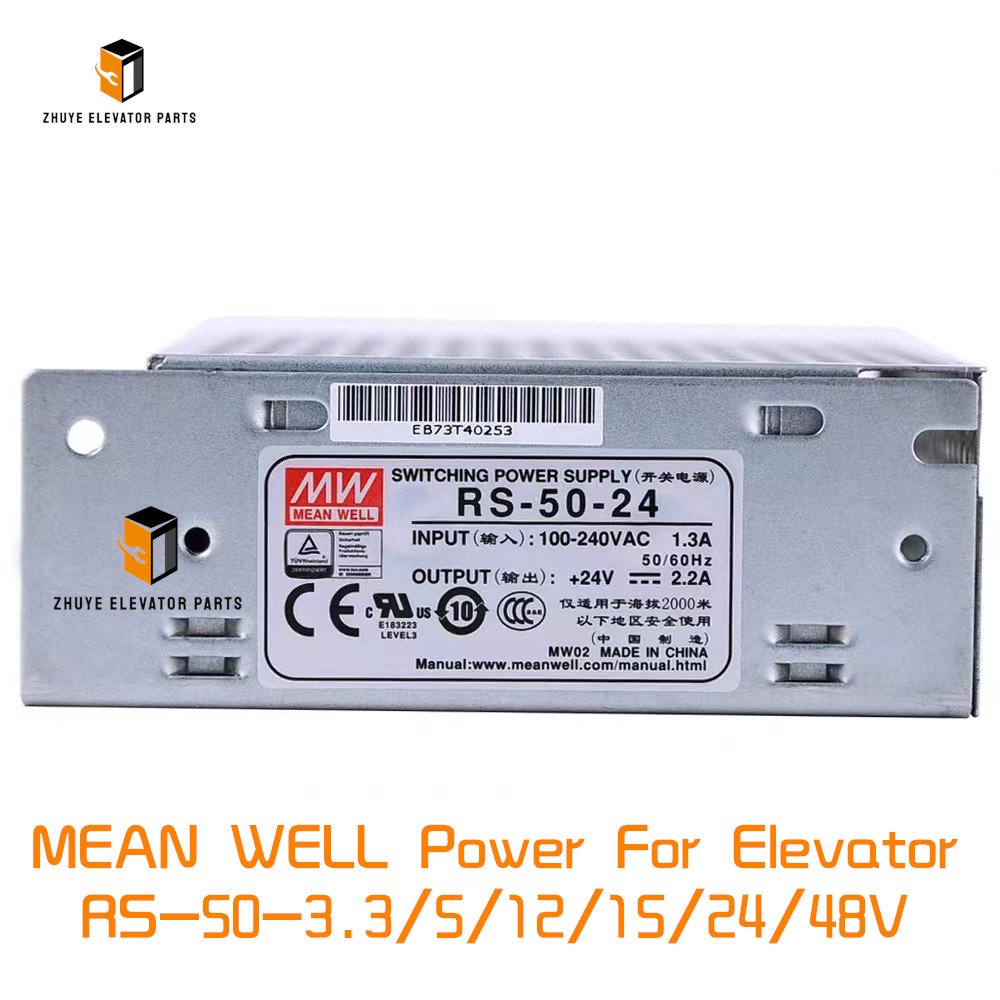
• UL 508, IEC 60950-1, EN 81-50 approved; MTBF 700 kh @ 25 °C per Telcordia SR-332.
• Universal input 85–264 VAC / 120–370 VDC—works on sites with brown-out down to 180 VAC. -
Part-number decoder (order exactly this, no guessing)
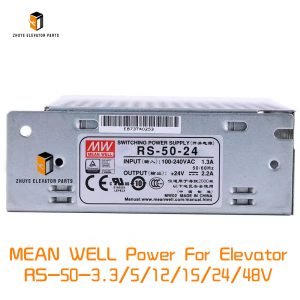
RS-50-3.3 → 3.3 V / 10 A
RS-50-5 → 5 V / 10 A
RS-50-12 → 12 V / 4.2 A
RS-50-15 → 15 V / 3.4 A
RS-50-24 → 24 V / 2.1 A (most common for 24 VDC brake & controller)
RS-50-48 → 48 V / 1.05 A (legacy door motor, PoE lifts)
All share the same 99 × 82 × 30 mm footprint; +S / –S remote sense pins are fitted on every model. -
Tools you will need
• Phillips #2 screwdriver
• 4 mm flat for DIN-rail clip
• Torque driver 0.8 N·m (for field terminals)
• Multimeter with 1 mV resolution
• Oscilloscope (optional, for ripple check)
• IR thermometer or thermal camera
• 2.5 mm² ferrules (strongly recommended—strands break under clamp) -
Mounting for zero derating
Snap the RS-50 onto 35 mm DIN rail (TS-35). Maintain 50 mm clearance above and 30 mm below; the lifetime halves for every 10 °C rise. If the cabinet is < 100 mm deep, mount vertically with input terminals down—this allows convection chimney. Never lay the supply flat on its side inside a wiring tray—temperature rises 15 °C and electrolytic life collapses to 2 years. Nanjing Zhuye supplies a free aluminium 1 U bracket (NY-BKT-RS50) for panel-mount when rail space is tight. -
Wiring & grounding
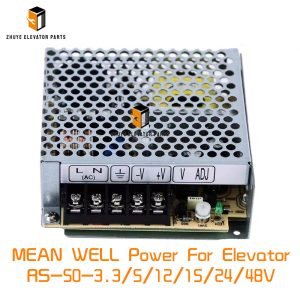
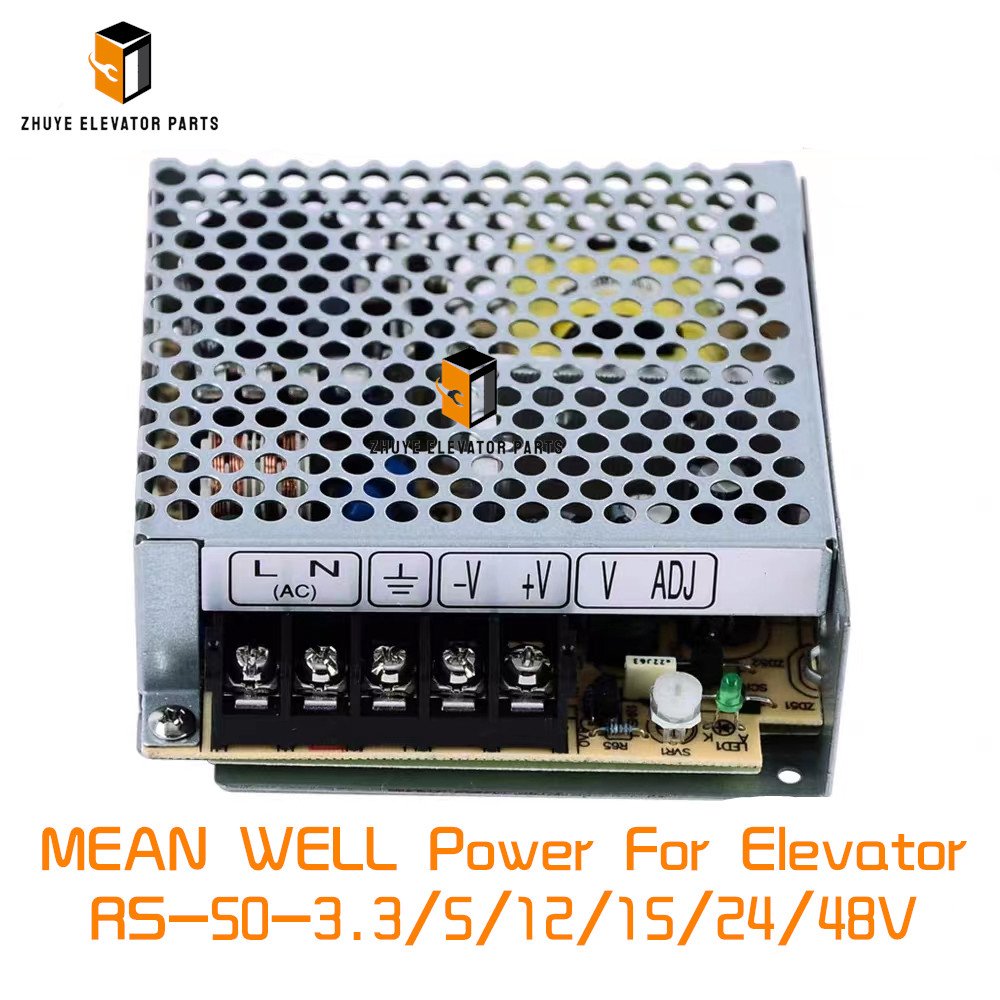
Input: 1.5 mm² is enough for 0.3 A @ 230 VAC, but use 2.5 mm² to minimise voltage drop on long risers. Ferrule both ends, torque L/N to 0.8 N·m—loose clamps arc and weld themselves.
Output: 24 V model needs 1.5 mm² for runs < 5 m; > 5 m upgrade to 2.5 mm² to keep drop < 0.25 V. Connect remote sense (+S to +V at load, –S to 0 V) if load current > 1 A or drop exceeds 0.1 V—this alone prevents 90 % of “low 24 V” callbacks.
PE: bond the supply’s PE stud to the cabinet earth bar with 4 mm² green/yellow; MEAN WELL Y-capacitor leaks 0.5 mA—floating PE gives 80 V touch voltage and false RCD trips. -
Power-up & validation
Apply power, no load: green LED = OK, red = over-temperature or over-load.
No-load output must be within ±0.2 V of nominal; adjust VR if needed (24 V model range 22–27 V).
Full-load test: connect 24 Ω, 50 W resistor (≈ 1 A). Ripple < 30 mVpp, temperature rise < 35 °C at 25 °C ambient.
Elevator functional test: run car to top floor, engage brake, measure 24 V at brake coil—must stay ≥ 22 V. Anything lower shortens coil life and causes late-leveling stops. -
Lifetime model & replacement cycle
Electrolytic capacitors are the wear item. MEAN WELL uses 105 °C, 3 000 h caps; at 50 °C Arrhenius predicts 48 000 h. Translate to elevator duty:
Light traffic (office, 8 h/day, 5 days/week) – 2 080 h/year → replace ≈ 23 years; inspect every 5 years.
Medium traffic (mall, 12 h/day, 7 days/week) – 4 380 h/year → inspect every 2 years, replace capacitors at year 6, full supply at year 12.
Heavy traffic (metro, 20 h/day) – 7 300 h/year → inspect every 6 months, replace capacitors every 3 years, full supply every 6 years.
Fan-less rule: if internal temperature (measured on the heat-sink) exceeds 70 °C, halve the interval. A $15 IR thermometer pays for itself the first prevented callback. -
Preventive maintenance checklist
Monthly: visual LED, listen for ticking (arcing input).
Quarterly: IR scan heat-sink; > 65 °C without load means failing cap or blocked vent.
Annually: torque test input screws; vibration loosens them.
Bi-annually: scope ripple at 50 % load; > 100 mVpp means order Nanjing Zhuye capacitor kit (NY-RS50-CAP-KIT: 2 × 470 µF, 200 V + 1 × 100 µF, 35 V). -
Capacitor replacement on-site (10 min)
Power down, wait 5 min for bus to fall < 5 V. Remove the two Phillips top screws, slide cover back 5 mm. De-solder old caps, insert new 105 °C low-ESR types (included in kit), polarity stripe toward the label. Re-assemble, re-torque screws 0.4 N·m. Power up, ripple must drop < 30 mVpp—if not, replace full supply. -
Full-supply swap (5 min)
Snap old unit off DIN rail, snap new Nanjing Zhuye RS-50 in place. Transfer wires one-by-one to avoid L-N reversal. Power up, verify green LED, run elevator inspection cycle, log serial number and date. Return failed unit in the same box—Nanjing Zhuye recycles: aluminium heat-sink remelted, copper windings smelted, PCB processed for gold/palladium. One recycled supply saves 6 kg CO₂—enough to power the same elevator for a week. -
Common field faults quick chart
Symptom: green LED but no output → over-load (remove brake coil short).
Symptom: red LED cycling → input under-voltage (brown-out < 85 VAC).
Symptom: LED OK, 24 V drops to 19 V under load → forgot remote sense, or wire gauge too light.
Symptom: 100 Hz ripple 200 mV → bulk cap failing, order kit or replace supply.
Symptom: random 0 V bursts → loose input ferrule, arcing, replace wire and re-torque.
By treating the MEAN WELL RS-50 as the heart of the 24 VDC circulatory system—not a commodity “black brick”—you eliminate 90 % of low-voltage callbacks, extend brake and encoder life, and keep the elevator ready to run even when the mains dips. Specify Nanjing Zhuye genuine stock, follow the temperature-based replacement table above, and the only thing your controller will ever feel is clean, cool, ripple-free power—shift after shift, year after year.