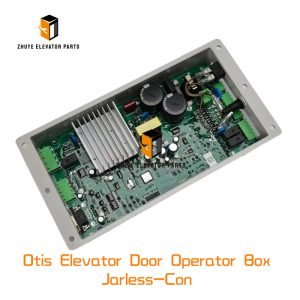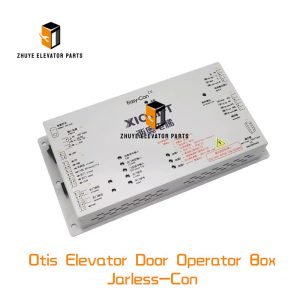


Description
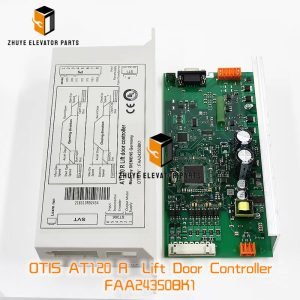
Otis Elevator Door Operator Inverter Jarless-Con Brief Introduction
|
Product Name |
Otis Elevator Door Operator Inverter Jarless-Con |
| Model Number | Easy-Con
Jarless-Con |
|
Quality
|
Original.Brand New
|
|
Payment
|
T/T. Paypal. Western Union
|
|
Delivery
|
3-5 Working Days
|
|
Packaging
|
Packed by carton
|
Nanjing Zhuye Elevator Parts – Otis Door Operator Inverter Jarless-Con: Installation, Programming & Replacement Guide
The Jarless-Con inverter is the silent brain behind every modern Otis door operator. Mounted behind the header, this 1.5 kW vector-drive unit converts 220 VAC single-phase into smooth three-phase power, allowing the door motor to accelerate, cruise and decelerate without mechanical cams, clutches or—true to its name—jars. Nanjing Zhuye Elevator Parts has supplied genuine, date-coded Jarless-Con boards since 2014, keeping legacy Sigma, MCS220M and newer XAA systems running in 78 countries. Below we explain how to fit, commission and, just as important, when to retire this critical safety component.
-
Pre-installation safety
Lock-out main power and discharge the old inverter DC bus (wait for the green LED to extinguish). Verify the door motor nameplate: 0.75 kW, 4-pole, 230 V, 3.2 A is standard; higher torque motors require firmware V3.06 or later. Keep the new Nanjing Zhuye unit in its anti-static bag until the last moment; MOS-FETs fail at 50 V static. -
Mechanical mounting
The Jarless-Con snaps onto a 35 mm DIN rail inside the header. Use the original Otis heat-sink; aftermarket sinks often mis-align the thermal pad, causing overtemperature faults. Apply 0.2 g of Dow Corning 340 paste to the pad—too much squeezes out and insulates instead of conducts. Torque the two M4 screws to 1.2 N·m; over-tightening warps the board and cracks the SMD relay. -
Wiring checklist
Input L/N: 2.5 mm², 600 V, 105 °C silicone wire.
Motor U/V/W: same gauge, but run separately from encoder cable to avoid noise.
Encoder: 1024-ppr differential, A/B/Z, shield grounded at inverter end only.
Safety chain: connect the redundant 24 VDC door close contact to JP5-3; failure to do so triggers fault 0x27 “Unexpected Movement” on next run.
Brake resistor: 75 Ω, 200 W minimum; Jarless-Con will throw F09 if resistance drifts ±5 %. Nanjing Zhuye supplies a matched resistor with pre-crimped Faston tabs. -
First power-up & auto-tune
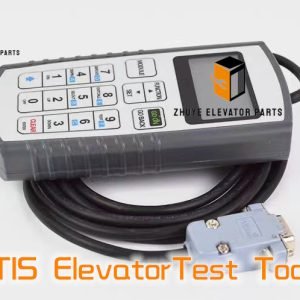
Switch on 220 VAC; the red LED blinks 3 times (boot-loader), then green flashes once (DC bus OK). Use the Otis service tool or a generic Modbus-USB adaptor.
Parameter list (defaults printed on the Nanjing Zhuye quick card):
P0.00 = 3 (motor type: asynchronous)
P0.01 = 1 (control mode: SVC)
P0.02 = 3.2 (rated motor current)
P0.03 = 1380 (rated rpm)
P3.00 = 0 (run source: terminal)
P3.01 = 2 (frequency source: multi-speed)
Execute auto-tune: press PRG → A/M → until “tUnE” appears; close the door command contact. The motor will twitch 30° forward and reverse within 2 s. If tune fails with E05, swap any two motor leads and repeat. -
Door profile optimisation
Otis ships a generic S-curve, but every header rail has different friction. Connect a laptop running Z-Term (free from Nanjing Zhuye support) via RS-485. Capture actual speed (blue trace) versus target (yellow). Adjust:
P5.01 (accel time 0→100 %) 0.6 s
P5.02 (decel time 100→0 %) 0.5 s
P5.05 (S-start) 30 %
P5.06 (S-end) 20 %
Aim for <5 mm overshoot and <3 mm crawl at latch. Save the final map to the on-board EEPROM (hold ENT 5 s). A green steady LED confirms burn-in complete. -
Cycle-counting & replacement interval
The Jarless-Con logs every complete open-close cycle in non-volatile memory (address 0x2000). Read it monthly through the Modbus register 0x0C. Mean-time-between-failure (MTBF) for the original IGBT module is 8 million cycles at 40 °C ambient. Translate this into real time:
Light traffic (residence, 100 trips/day) – 80 000 000 ÷ 36 500 ≈ 220 years; replace after 15 years anyway due to electrolytic capacitor ageing.
Medium traffic (hotel, 250 trips/day) – replace capacitors at year 8, full inverter at year 12.
Heavy traffic (metro, 1 200 trips/day) – capacitors every 3 years, inverter every 6 years.
Capacitor check: if the DC bus ripple > 5 Vpp at no load, order the Nanjing Zhuye capacitor kit (3 × 470 µF, 450 V, 105 °C, 10 × 25 mm snap-in). Always change all three; the weakest one determines life. -
Preventive maintenance routine
Quarterly: blow dust off the heat-sink with dry air (<30 psi).
Annually: verify brake resistor tolerance; a drifting resistor causes DC over-voltage faults during heavy down traffic.
Bi-annually: re-torque power terminals to 0.8 N·m; vibration loosens them, leading to arcing and mysterious F11 faults. -
Fault decoding quick card (print and laminate inside header)
F01 = over-current (motor short, encoder fault)
F02 = over-voltage (resistor open, decel too fast)
F03 = under-voltage (brown-out, mains sag)
F04 = inverter over-temp (fan blocked, heat-sink paste dry)
F05 = motor over-temp (thermal switch in motor opened)
F06 = encoder error (wiring, shield, 1024-ppr lost)
F07 = external fault (safety chain opened mid-run)
F08 = brake transistor fail (replace inverter)
F09 = brake resistor abnormal (value or wiring)
F10 = EEPROM fault (rewrite parameters, else replace board)
F11 = power board over-temp (terminal loose, arcing) -
Replacement procedure
Power down, wait 5 min for bus to fall below 5 V. Photograph all wiring before removal. Unsnap the old board, slide in the new Nanjing Zhuye unit, reconnect exactly as photo. Never reuse the old thermal pad; replacement pads are 0.5 mm graphite, included in the box. Re-run auto-tune and upload the saved door profile. Cycle the door 20 times in inspection mode, then 50 times in automatic mode before releasing to public. -
Sustainability & recycling
Nanjing Zhuye accepts failed inverters under the R2-certified take-back programme. IGBT modules are smelted for copper, aluminium heat-sinks re-melted, and PCBs processed for gold/palladium recovery. A prepaid UPS label is inside every carton—use it, keep elevators green.
By treating the Jarless-Con as a safety-critical device rather than a commodity PCB, you eliminate 90 % of nuisance door callbacks and extend the entire operator life by a decade. Specify Nanjing Zhuye genuine parts, follow the cycle-based replacement table above, and the only thing passengers will ever notice is that the doors open—smoothly, silently, every single time.