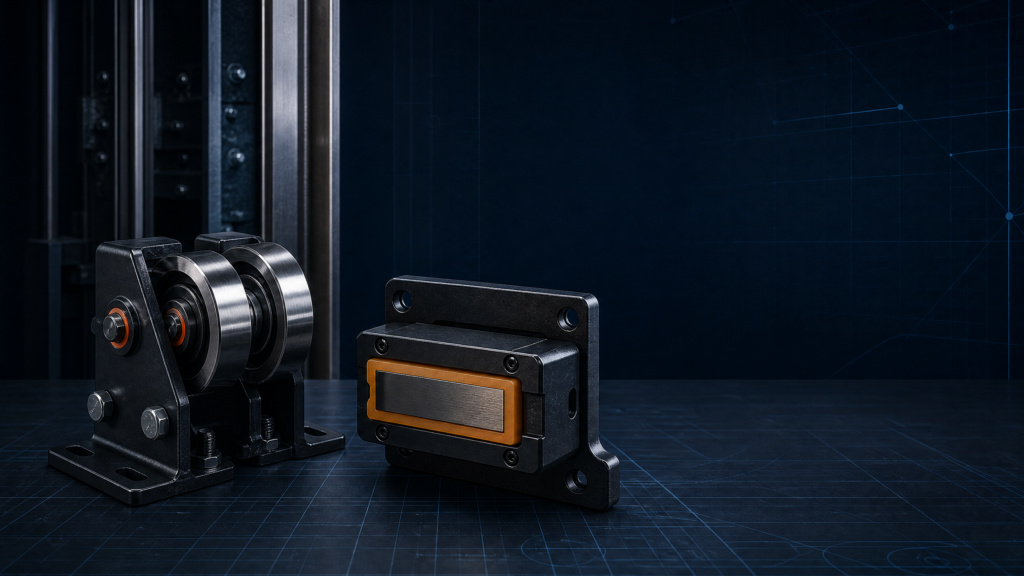
Guide shoes help keep the elevator car or counterweight aligned with the guide rail. For buyers, correct identification is important because the guide shoe type, rail size, mounting arrangement and liner or roller dimensions must suit the installed equipment.
Understand the two common guide shoe designs
Sliding guide shoes use a liner or insert that contacts the rail. They are commonly specified with exact liner dimensions, material and mounting details. Roller guide shoes use rollers to guide the car along the rail and often require precise information about roller diameter, bearing configuration, adjustment arrangement and bracket geometry. The correct type is determined by the original design and the elevator application.
What to measure before ordering
- Guide rail size or rail-face dimensions.
- Overall guide shoe model and part number, if available.
- Roller or liner dimensions, including width, diameter and thickness where relevant.
- Mounting hole pattern, bracket shape and left/right orientation.
- Car or counterweight application and the associated elevator brand or system.
- Clear photographs of the full assembly and close-ups of worn components.
Replace the correct component
Sometimes only a liner, roller, bearing or retaining part needs replacement; other cases require the complete assembly. Share photos of the worn item and the assembly it came from. This helps distinguish a guide shoe liner from a roller guide shoe component and reduces the risk of ordering an item that cannot be fitted.
Focus on application fit
Do not choose a guide shoe only by appearance. Rail dimensions, load, speed, mounting arrangement and the original equipment design all affect selection. Installation and adjustment should be carried out by trained professionals according to applicable safety procedures.
Request elevator guide shoe support
Browse the available elevator parts range and send an enquiry with dimensions, part numbers and images. Our FAQ explains the information that helps suppliers verify a replacement request.